Los Gagones: The Crying White Ghost Dogs of Old Cuenca That Exposed Forbidden Love Affairs
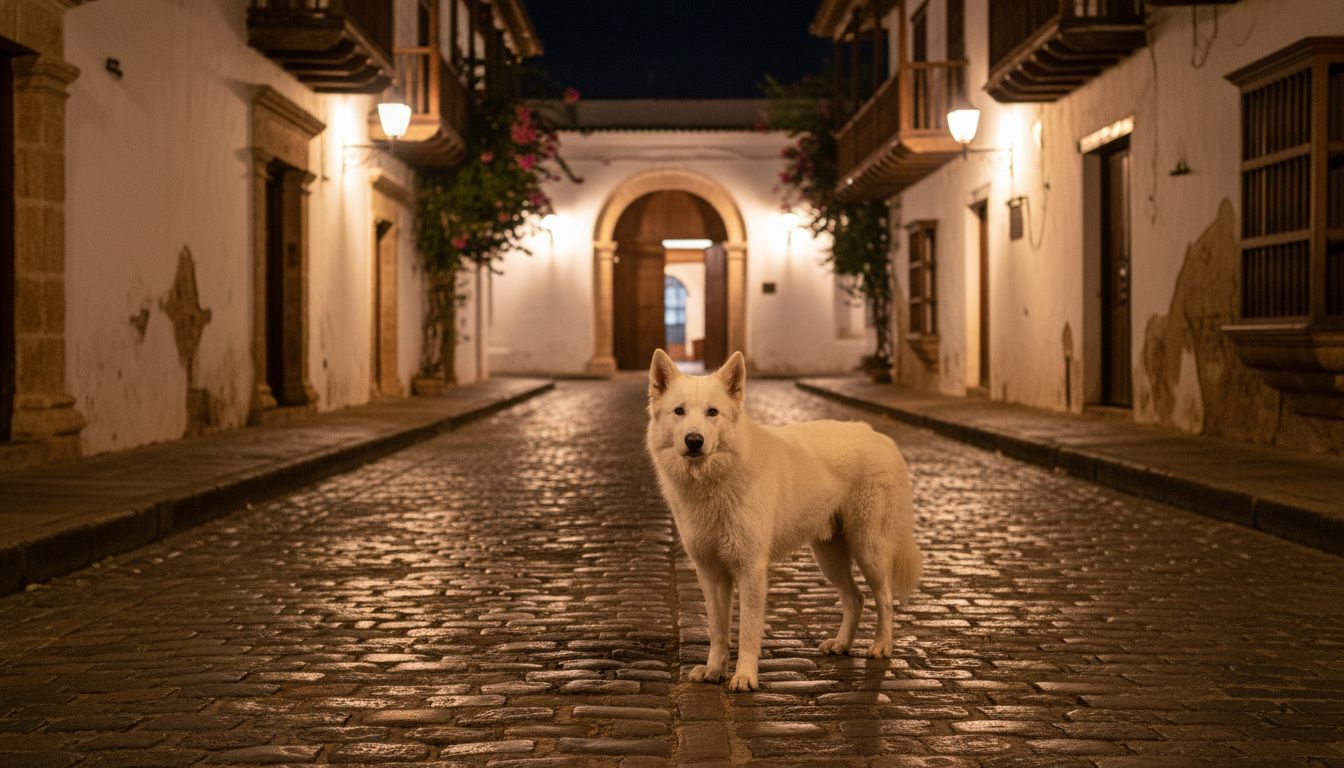
Los Gagones: The Crying White Ghost Dogs of Old Cuenca That Exposed Forbidden Love Affairs
The Legend That Still Haunts Cuenca's Cobblestones
Long before streaming gossip and group chats, Cuencanos had another way of knowing who was being unfaithful: the cry of a ghost dog in the night. Los Gagones are a fixture of Cuencano oral tradition, passed down through generations of families who grew up walking the same narrow streets lined with whitewashed colonial walls. Many longtime residents recall being warned as children not to go out after a certain hour, lest they hear the mournful wail believed to herald scandal.
This piece is offered as a cultural retelling, not an investigative report. It draws on the kind of story an expat might first hear from a neighbor, a market vendor, or an elderly tenant of a centuries-old house—delivered in hushed tones, with a knowing smile, as though the teller half-believes it and half-enjoys watching your reaction. That mixture of belief and theater is, in many ways, the heart of the legend itself.
Who (or What) Are the Gagones?
According to those who recount the legend, the Gagones are pale, almost translucent dogs that appear at night in Cuenca's older neighborhoods. Their fur seems to glow faintly in the moonlight, locals say, and they move in a way many describe as unnatural—too silent, too deliberate, as if they do not quite belong to the physical world. Their defining feature, storytellers agree, is the eerie, drawn-out cry they emit: not quite a howl, not quite a whimper, but something in between that is said to unsettle anyone within earshot.
In the telling of many locals, the Gagones are not simply spooky animals but omens. Their appearance, or the sound of their cry near a particular home, is said to signal infidelity—a spouse's secret affair, a forbidden tryst, a betrayal hidden from the household. As with most oral traditions, the specifics shift depending on who is telling the story. Some recount that the dog appears only to the betrayed partner; others insist the whole street can hear the cry. Details change from household to household and generation to generation, and that variability is itself a hallmark of folklore rather than documented history.
A Story Often Told: How the Gagones Expose Secret Affairs
One version of the tale, as it is often recounted by locals, goes something like this: a woman married to a traveling merchant begins to suspect he has taken up with another woman across town. Night after night, neighbors say, a white dog is seen pacing outside the merchant's house, crying softly until dawn. Eventually, so the story goes, the affair comes to light, and the dog is never seen again. Whether this particular account happened once, many times, or not at all in any literal sense is impossible to say—it is presented here strictly as a representative piece of local storytelling, not a documented event.
What makes the legend endure, many who share it suggest, is less the supernatural mechanics and more the social commentary folded inside it. In a tightly-knit colonial town where reputations traveled fast and privacy was scarce, a story like this functioned as a kind of communal enforcer—a reminder that secrets rarely stayed secret, and that the community was always, in some sense, watching. The Gagones, in this reading, are less about ghosts and more about shame, exposure, and the fear of being found out.
Roots in Andean Ghost-Animal Folklore
Los Gagones do not exist in isolation. Across the Andean region, stories of spectral or omen-bearing animals—dogs in particular—appear in various forms, often tied to death, moral transgression, or hidden truths coming to light. Ghost dogs, black or white, recur frequently enough in regional folklore that some cultural observers see Los Gagones as a local variation on a much older, widespread archetype rather than a wholly unique invention.
It is worth noting, cautiously, that such legends often encode moral taboos—infidelity, secrecy, social betrayal—within a supernatural framework, perhaps because fear of the otherworldly proved more persuasive than any sermon about trust and loyalty. Some have speculated, purely as conjecture, that tales like this may reflect a blending of colonial-era Catholic moral anxieties with older indigenous beliefs about animals as spiritual messengers or omens. This remains speculative; no documented historical sources tracing the specific origin of Los Gagones were available for this retelling, and the legend appears to survive almost entirely through oral transmission rather than written record.
Why the Legend Endures for Expats and Locals Alike
In a city that has modernized considerably—with cafés, co-working spaces, and a growing international community—it might seem surprising that a legend about crying ghost dogs still gets passed along at dinner tables and taxi rides. Yet for many residents, old and new, these stories persist precisely because they connect the present city to its older, more intimate past, when everyone seemed to know everyone else's business.
For expats, encountering a legend like Los Gagones often becomes a small but meaningful part of cultural immersion—a signal that you are no longer just visiting Cuenca, but beginning to absorb its inner life, its humor, and its unspoken rules. Whether or not anyone truly believes a ghost dog can expose an affair, the story still does quiet social work: reminding listeners, even today, that community memory is long, and that some truths have a way of surfacing eventually. So if you find yourself walking Cuenca's older streets after dark and hear something that sounds like a cry carried on the wind, you might just be hearing the echo of a story many generations have chosen to keep alive.