La Churonita Goes Home: An Expat Witnesses Loja's Virgin of El Cisne Return to Her Sanctuary
La Churonita Goes Home: An Expat Witnesses Loja's Virgin of El Cisne Return to Her Sanctuary
There is a particular hush that falls over Loja in the days before the Virgin of El Cisne begins her journey home. Streets normally busy with ordinary commerce take on a different rhythm, and a sense of anticipation builds among residents who have known this tradition since childhood. For an expat still learning the cadences of Ecuadorian life, arriving in the city during this season means stepping into something far older and deeper than a typical local event. Many visitors are told the return procession tends to happen around mid-November, though exact dates shift from year to year and are worth confirming with local parish or tourism sources before planning a visit.
Affectionately known as "La Churonita," the Virgin of El Cisne is one of the most beloved Marian images in southern Ecuador, and her annual journey between the town of El Cisne and the Cathedral of Loja is considered by many locals to be a cornerstone of the region's spiritual identity. This piece is offered as a personal, observational account of encountering that tradition as an outsider, with respect for its depth and an acknowledgment that many details of the practice are best understood through lived experience and local guidance rather than any single telling.
Who Is La Churonita? A Tradition Rooted in Faith
According to long-standing local devotion, the image of the Virgin of El Cisne has been venerated in the Loja province for generations, with her sanctuary located in the small town of El Cisne. Many residents describe an annual cycle in which the image travels to the Cathedral of Loja around September, remaining there for weeks of religious observance and civic celebration, before being returned to her home sanctuary later in the year, often associated with November.
The precise historical origins and liturgical details of this devotion are best confirmed through local parish records or regional historical accounts, but what seems consistent across community retellings is the sense of continuity the tradition represents. Families speak of attending the procession across generations, and the rhythm of the Virgin's departure and return appears to function as a kind of spiritual calendar for the region, marking time in a way that predates any individual observer's presence in Loja.
Witnessing the Regreso: Crowds, Candles, and Community
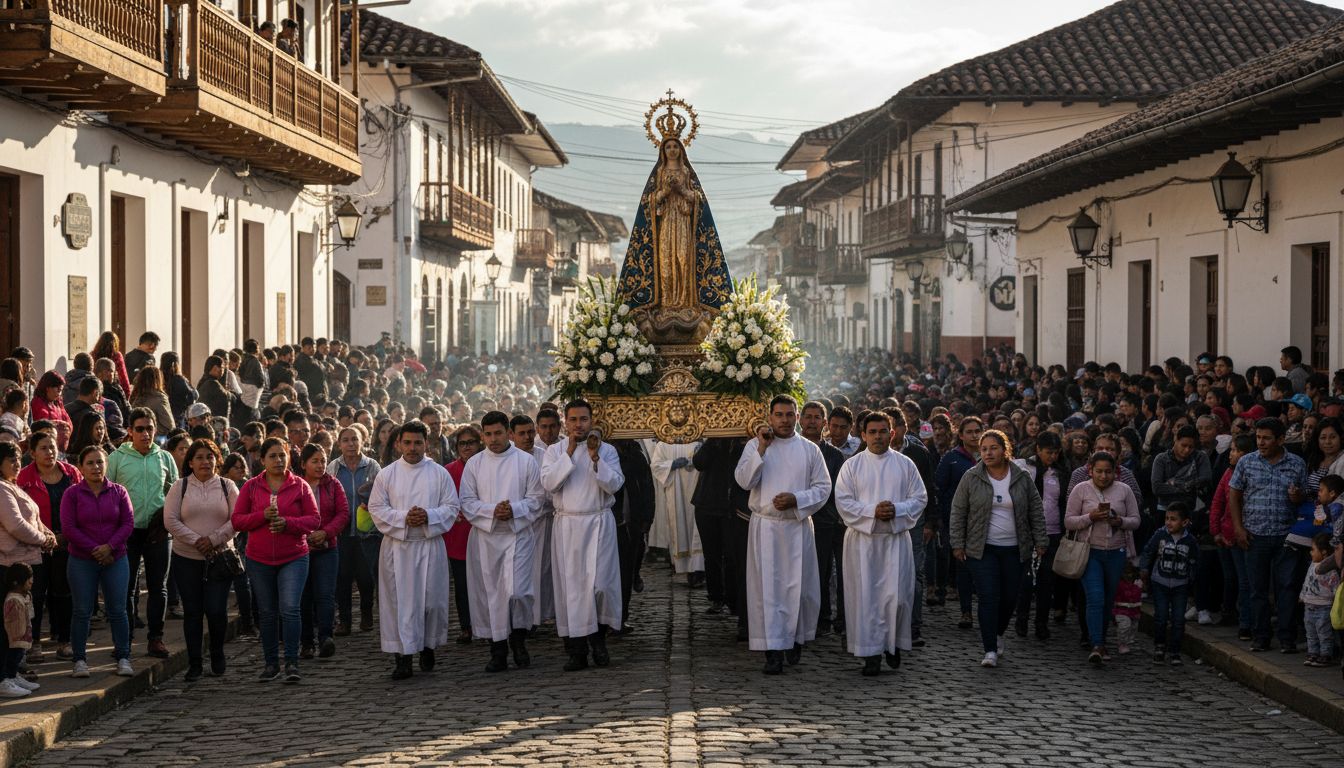
To stand along the route during the return journey, often called the "regreso," is to be enveloped in a sensory experience unlike most everyday occasions. Pilgrims move in dense, slow-moving crowds, many walking long distances as an act of devotion. Chanting and prayer rise and fall in waves along the procession route, occasionally joined by hymns carried through portable speakers or sung directly by groups of the faithful.
As evening approaches, candlelight becomes a defining feature of the scene, with flickering flames held by pilgrims young and old alike. The scent of incense drifts through the crowd, mixing with the cooler mountain air typical of Loja's elevation. Vendors along the periphery sell food, devotional items, and candles, while entire families appear to treat the event as both sacred pilgrimage and shared communal gathering. For an outside observer, the sheer scale of participation can be striking: local life seems to reorganize itself around the procession, with normal routines paused in favor of collective presence.
An Expat's Reflection: Finding Meaning in Someone Else's Faith
Watching such a procession as a foreign resident invites a particular kind of humility. It is not one's own tradition, not one's own childhood memory, and yet something in the collective devotion is difficult not to feel moved by. There is a temptation, perhaps common among newcomers, to intellectualize the experience—to analyze its history or compare it to other religious processions witnessed elsewhere. But standing quietly at the edge of the crowd, many expats may find that the more honest response is simply to observe, to let the moment exist without needing to fully categorize it.
This kind of witnessing can reshape how one thinks about community and belonging. It becomes clear that belonging, in this context, is not something an outsider is necessarily meant to claim, but it can still be something one is invited to respectfully witness. The experience often raises quiet questions: what does it mean to live within a culture's major milestones without having grown up inside them? How does one honor a tradition that isn't one's own, without appropriating or diminishing its significance? There may be no definitive answers, only the ongoing practice of attentive, respectful presence.
Practical Notes for Expats and Travelers
For those considering attending the return procession or related festivities, a few general principles of respectful conduct are worth keeping in mind. Modest, conservative dress is generally appropriate near religious sites and during the procession itself. Quiet, respectful behavior is expected along the route, particularly near moments of prayer or ritual significance. Photography is often possible, but discretion is advised—large cameras, flash photography, or intrusive behavior near worshippers can be seen as disruptive, and visitors are encouraged to be mindful of the solemnity many participants bring to the occasion.
Because specific dates, routes, and logistical details can vary from year to year, it is strongly recommended that anyone planning to attend verify current information directly with the Loja parish, diocese communications, or local tourism offices closer to the event. Travelers should also anticipate significant crowds, limited parking, and possible changes to normal transportation patterns in and around Loja during this period. Booking accommodations well in advance is advisable, as lodging in the city can fill quickly during major religious observances.
Closing: Why Traditions Like This Matter
Traditions like the return of La Churonita endure not simply as historical curiosities but as living threads connecting generations of a community to one another and to their shared sense of place. For expats, witnessing such an event offers a rare opportunity to glimpse the deep cultural and spiritual fabric of a region that existed long before their arrival and will continue long after they move on.
There is something valuable in recognizing that not every tradition needs to be fully understood to be respected. Sometimes the most meaningful posture is simply to observe quietly, ask thoughtful questions of local friends and neighbors, and allow space for traditions to remain exactly as rich and complex as their originating community intends them to be. In doing so, expats may find that their understanding of Ecuador—and perhaps of their own relationship to home and belonging—continues to deepen long after the candles have been extinguished and the procession has returned to rest.