La Caja Ronca: The Hoarse Drum Said to Lead Ibarra's Procession of the Dead
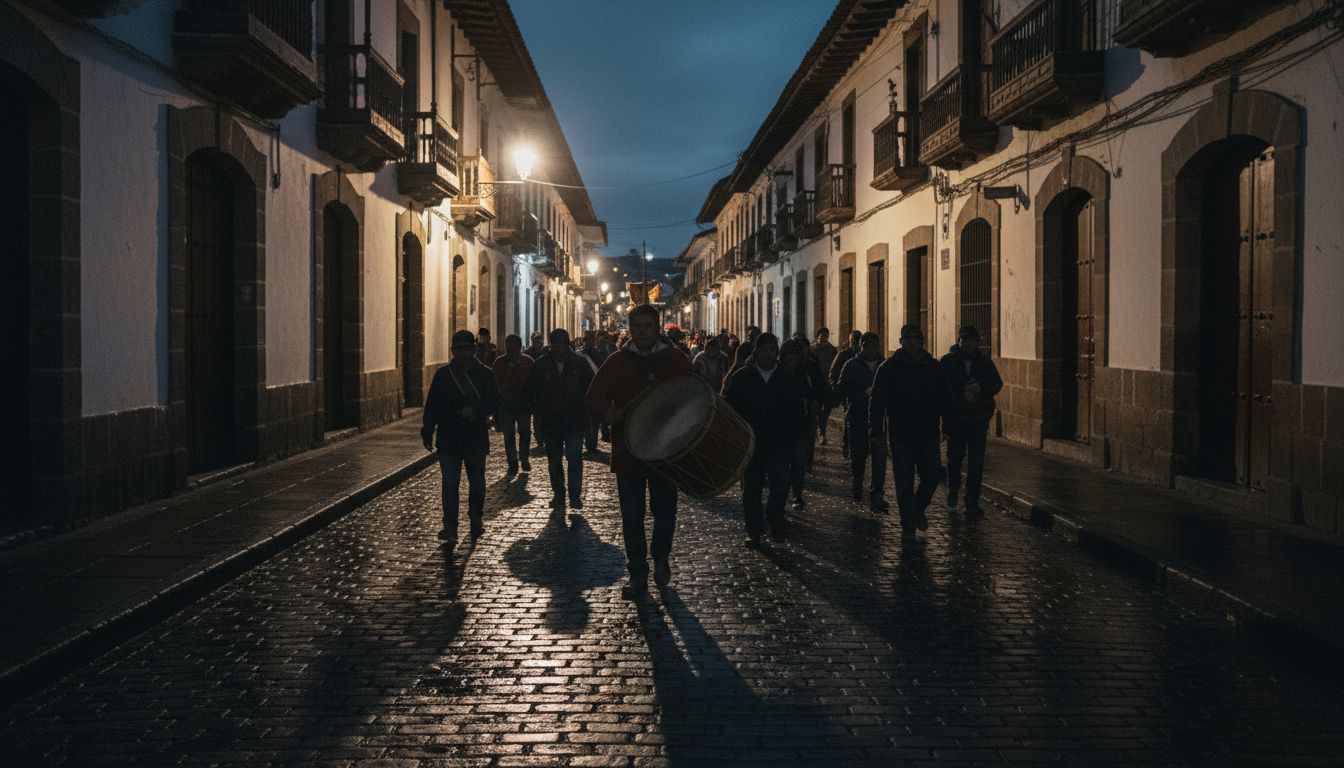
The first time I heard it, I thought a neighbor was moving furniture very slowly, very badly, at two in the morning. But the sound didn't stay indoors. It moved—low, hoarse, irregular, like a drum wrapped in wet cloth—drifting up through the cobblestone streets of Ibarra and settling somewhere behind my ribs. I sat up in bed. I turned off the fan so I could listen. It did not sound like music. It sounded like something being announced.
I am not from here. I have lived in this Andean highland city long enough to recognize the ordinary night sounds—dogs, buses grinding gears on the hills, the occasional firework for a saint's day. This was not one of those. It had no rhythm I could name, only a dragging, muffled cadence that seemed to come from everywhere and nowhere, the way fog does. When I asked about it the next morning, a neighbor simply said, "Ah. La Caja Ronca," and left it at that, as though the name alone should have settled my nerves. It did not.
What Is La Caja Ronca? Unpacking the Legend
La Caja Ronca translates roughly to "the hoarse box" or "the hoarse drum," and in Ibarra's local lore, it refers to a spectral drum said to lead a ghostly procession of the dead through the city's streets. According to the stories told here, the drum itself is no ordinary instrument—its skin is said to be worn or damaged in a way that produces a muffled, rasping tone, distinct from any festival drum you'd hear during a parade. It is described less as music and more as a herald: a sound that announces something is passing, and that the living should not look too closely.
Many residents trace the tradition back to the 1800s, though it's important to be clear about what that claim actually rests on. This is oral tradition—stories passed through families, neighborhoods, and generations—rather than something documented in written records I've been able to locate. The specific origin point, the first person to describe it, the exact century it took hold: these details live in community memory, not in archives. That doesn't make the story less real to the people who tell it, but it does mean the historical specifics should be treated as unverified local lore rather than settled fact.
Roots in Faith and Fear: Catholic-Indigenous Syncretism
Ecuador's highlands carry a long history of Catholic and Indigenous belief systems intertwining, and La Caja Ronca seems to sit somewhere in that blend. Some locals connect the legend to All Souls' Day or broader Day of the Dead observances, when the boundary between the living and the dead is culturally understood to thin. Others describe it more as an Andean mourning custom, a way of dramatizing grief and remembrance rather than a literal religious rite tied to a specific Catholic feast day.
It's worth being cautious here rather than authoritative. I have not found academic or institutional sources that trace a clean line from any single Catholic or Indigenous practice to this specific legend. What seems more likely, based on how people describe it, is that La Caja Ronca functions the way many such stories do across cultures: as a moral and communal tool. A drum in the night that warns children to be inside, that reminds adults to speak carefully of the dead, that reinforces a kind of respectful hush around mortality. Whether it originated as a literal spiritual belief, a disciplinary tactic for parents, or some blend of both is something the story itself doesn't fully resolve.
Living Memory: How Locals Talk About La Caja Ronca Today
What struck me most, once I started asking around, was the range of ways people related to the story. Some spoke of it the way you'd speak of a ghost story you don't quite believe but wouldn't test either—half amusement, half genuine unease. Others were more matter-of-fact, treating it as simply part of the texture of the city, something grandparents mention when a child stays out too late.
There isn't one version. In some accounts, the procession is something people claim to have seen—shadowy figures following the drum's sound. In others, it's purely auditory, a sound with no visible source, which somehow feels more unsettling. A few neighbors described it as more of a seasonal thing, tied to certain nights of the year, while others suggested it could happen at almost any time, unpredictably. I want to be honest that I have not found journalistic or institutional documentation confirming any of this as an organized, literal event. What I can say is that the belief—and the sound—are alive in how people here talk, warn, and remember.
An Expat's Reckoning with the Unexplainable
I tried, for a while, to run this down the way I'd run down any other story: asking specific questions, looking for a name, a date, a written account. What I got instead were fragments—a cousin's story, a grandmother's warning, a shrug and a half-smile. At some point I had to sit with the fact that this wasn't a story built to be verified. It was built to be carried.
There's a particular discomfort, as an outsider, in wanting to categorize something—myth, event, exaggeration—when the community itself isn't asking that question. Living here has meant learning to let some things stay unresolved, to hear the hoarse drum in the night and not immediately reach for an explanation, but instead just listen, the way generations of Ibarra residents apparently have. I don't know if I believe in La Caja Ronca. But I've stopped needing to. Some nights, that's enough—to live inside a place's mysteries instead of solving them, and to understand that belonging here means making room for what I can't fully explain.