Kintia Panki, the Boa That Darkens: An Outsider's Account of a Shuar Waterfall Cleansing Near Sucúa
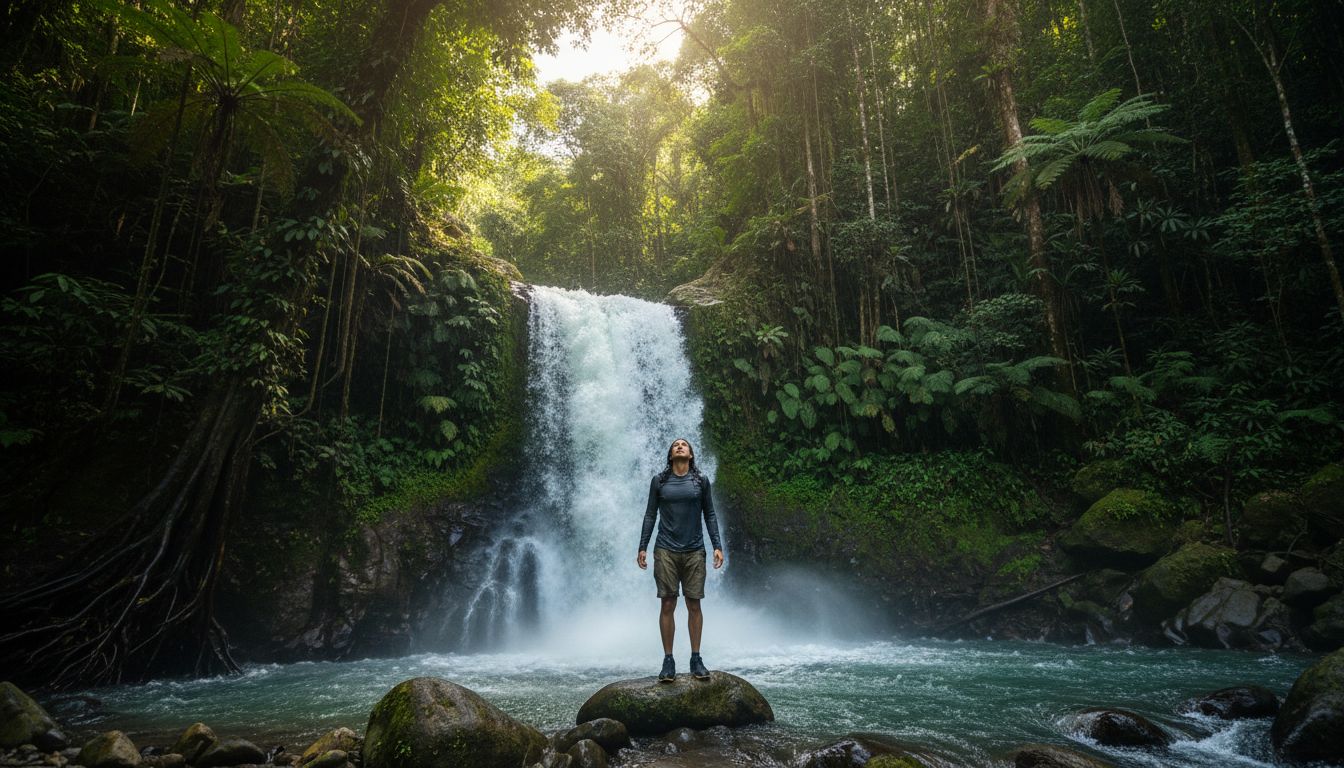
Kintia Panki, the Boa That Darkens: An Outsider's Account of a Shuar Waterfall Cleansing Near Sucúa
Sucúa sits at the edge of the Amazon basin, a small town in Morona Santiago where the pavement gives way to red dirt roads and the jungle presses close on every side. I had been living there only a few months when I first heard the name Arutam spoken—not in a textbook or a museum placard, but across a kitchen table, in the unhurried way that important things are sometimes shared. This is an account of what followed: an invitation to witness a Shuar waterfall cleansing, and an encounter with a figure I was told is called Kintia Panki, the boa that darkens.
Arrival in Sucúa: A Stranger at the Edge of the Jungle
My first weeks in Sucúa were disorienting in the way any unfamiliar place can be. The air felt heavier than in the highlands I had grown used to elsewhere in Ecuador, and the rhythms of the town—market mornings, afternoon downpours, the sound of the river never far away—took time to learn. I hadn't arrived looking for spiritual experiences; I had arrived looking for a quieter life closer to nature.
The invitation came through a friend of a friend, a Shuar man who had grown up near Sucúa. After several long conversations about life, land, and what it meant to be a foreigner settling in his region, he asked if I would like to accompany him and his family to a waterfall the following week. He described it only briefly: a cleansing, something tied to tradition, something for strength. I said yes, though I understood I was being allowed to witness something far outside my own frame of reference, and that this trust was not something to take lightly.
In the days before we went, I felt a mix of curiosity and caution. I didn't want to treat the invitation as a spectacle, nor did I want to decline out of excessive self-consciousness and miss a chance to learn, however partially, from people generous enough to include me.
Understanding Arutam: The Vision That Shapes a Life
What I know about Arutam, I know secondhand, from conversations with my host and others who joined us that day. I want to be clear that what follows is their account as relayed to me, not a scholarly summary, and readers interested in a fuller or more rigorous treatment of Shuar cosmology should seek out ethnographic sources rather than rely on my impressions alone.
As it was explained to me, Arutam is often described as a vision or spiritual power that a person may seek and, if fortunate, receive—something that can shape courage, identity, and one's place within the community. Waterfalls were described to me as significant sites for this kind of seeking, places where the force of falling water is thought to hold a particular spiritual charge. My host spoke of past generations undertaking vision quests at such sites, though he was careful to note that practices have evolved over time and vary between families and communities.
I want to underline that the terminology and cosmological details here are presented exactly as they were relayed to me by my hosts, not as verified academic fact. Shuar spiritual tradition is rich, internally diverse, and not something I am positioned to authoritatively explain after a single day's experience.
Kintia Panki: The Boa That Darkens
It was at the waterfall itself that I first heard the name Kintia Panki. One of the elders present, speaking partly in Spanish and partly through my host's translation, referred to a boa spirit associated with the site—described to me as "the one that darkens," connected in some way to the power sought at the waterfall. I could not independently verify this name, its precise meaning, or how widely it is used among Shuar communities beyond that moment. I attribute it directly to the elder and my host, who shared it with me in good faith as part of explaining what we were about to do.
What struck me was not the name itself so much as the evident seriousness with which it was spoken—lowered voices, a pause before the explanation continued, a sense that this was not casual information but something handled with care. Whatever Kintia Panki represents within the fuller context of Shuar belief, in that moment it carried real symbolic weight for the people around me, framing the waterfall not simply as a scenic backdrop but as a threshold.
At the Waterfall: The Cleansing Ritual Itself
The waterfall was perhaps a forty-minute walk from the nearest road, down a muddy trail that narrowed as the sound of rushing water grew louder. When we arrived, the cold was immediate—the air around the falls felt several degrees cooler than the jungle we had walked through, and the spray carried a fine, constant mist.
I want to be careful here to describe only what I observed and was permitted to participate in, without claiming any expertise in the ritual's full meaning. My host and two family members entered the pool beneath the falls, standing beneath the falling water for a period that felt long to me as an observer, though I couldn't say with confidence how its duration was determined. An elder stood nearby, speaking what I understood to be words of guidance or blessing, though I don't speak Shuar and relied on partial translation.
I was invited to stand at the edge of the pool, not beneath the falls themselves, and was told this was appropriate given my role as a guest rather than a participant seeking Arutam directly. The instructions I received were brief and practical—where to stand, when to be quiet, when it was acceptable to ask questions—delivered patiently by my host, who seemed aware that I was absorbing far more than I could process in the moment.
Reflections: Witnessing a Living Tradition as an Outsider
Walking back from the waterfall, I felt the particular quiet that follows an experience you know you don't fully understand. I was moved by what I had seen, but wary of overstating my own comprehension of it. A recurring thought stayed with me afterward: that being allowed to witness something doesn't grant ownership of it, or authority to explain it on others' behalf.
I have tried, in writing this account, to hold two things at once—gratitude for the trust extended to me, and caution against exoticizing or flattening a living spiritual tradition into something simpler than it is. Kintia Panki, Arutam, the waterfall itself: these are living elements of Shuar belief and practice, not artifacts for an outsider's narrative convenience.
As an expat in Ecuador, the afternoon reshaped how I think about the privilege of presence—the fact that I had been invited into a space I had no inherent claim to, and the responsibility that comes with that. I left Sucúa's waterfall with more questions than answers, and I think that is probably the appropriate place to be.