Inside Tabacundo’s San Pedro Fiesta
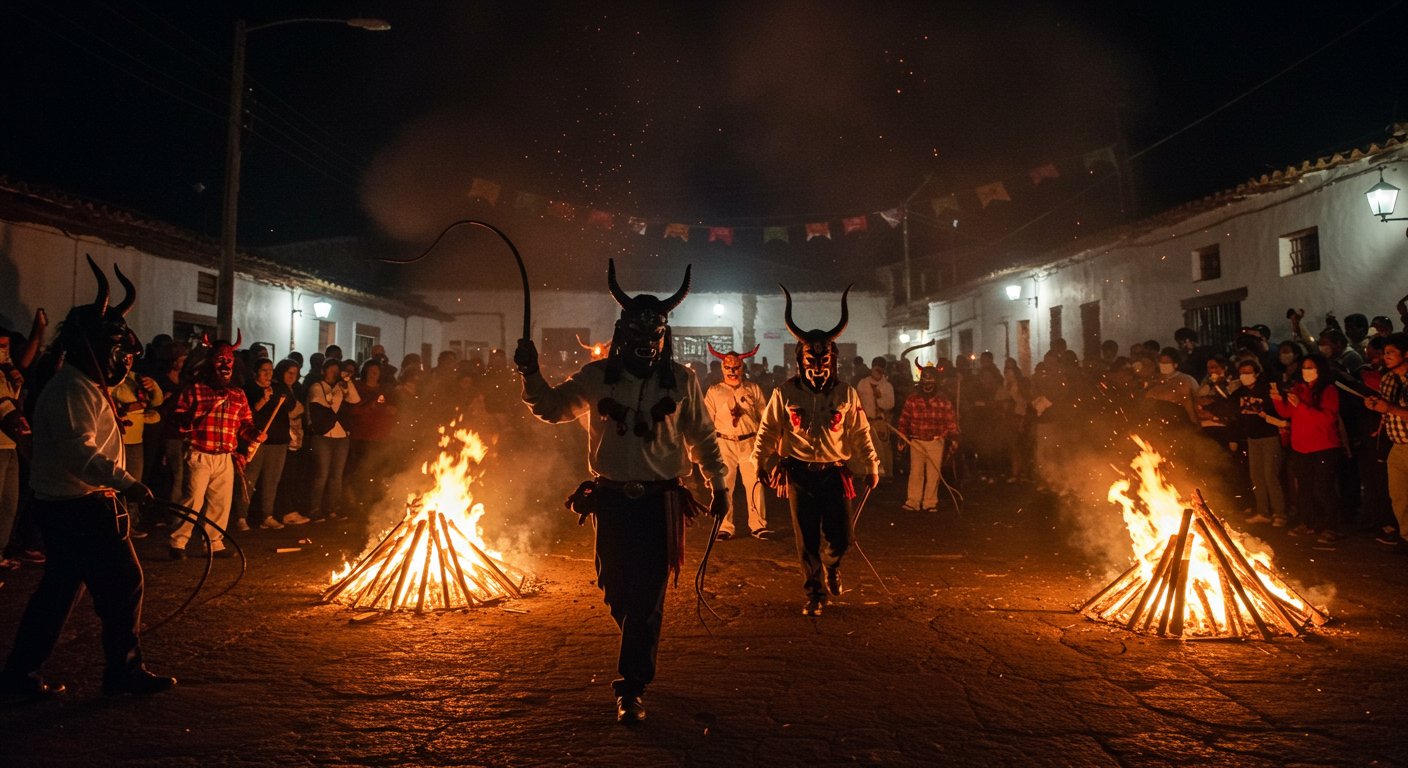
I arrived in Tabacundo thinking I was headed to a town celebration. Within minutes, it was obvious I had badly underestimated what that meant.
The streets were already full before the main action even began. Music drifted in from one direction, then another, never staying far away for long. Families lined the sidewalks as if waiting for something they knew by heart. Children darted through the crowd. Costumes appeared in fragments at first—bright fabric here, a mask there—until the whole town began to feel less like a place hosting an event and more like a stage the event had taken over.
There was smoke in the air, the smell of dust and food, and that particular buzz that comes when everyone around you seems to understand the rules except you. As an outsider, that feeling can be unsettling for about thirty seconds. After that, it becomes thrilling.
The First Shock of the Aruchicos
I heard the aruchicos before I fully saw them. The sound that cut through everything else was the crack of whips—sharp, explosive, impossible to ignore. It changed the mood instantly. Conversations paused. Heads turned. Even when you knew another crack was coming, your body still reacted before your mind did.
Up close, the performance felt less like chaos than control. The whip cracks were startling, but they were also precise, part of a larger flow of steps, spacing, timing, and presence. That was what struck me most: not just the intensity, but the discipline behind it.
From the edge of the crowd, the aruchicos felt both celebratory and intimidating. They carried the kind of energy that makes spectators lean back while also trying to see more clearly. You don’t watch passively. You stay alert. You feel the performance in your shoulders.
Meeting the Diablumas Face to Face
If the aruchicos announced themselves with sound, the diablumas took over through image. The masks were the first thing that held me: devil-faced, exaggerated, theatrical, and impossible to dismiss with a quick glance. Some looked fierce, some almost playful, and some deeply strange in the way only old festive traditions can be strange—half performance, half presence.
The effect on the crowd was immediate and varied. Small children stayed close to adults, staring with that mix of fear and fascination that masks seem to provoke everywhere. Visitors raised phones, then sometimes lowered them again, realizing a photo would capture the shape but not the feeling. Locals, by contrast, often seemed entirely at ease, as though these figures belonged not to spectacle but to memory.
That difference stayed with me. To a newcomer, the diablumas can feel surreal, even confrontational. To people who grew up with the fiesta, they seemed to be something else entirely: expected, meaningful, woven into the celebration in ways a passing visitor can sense without ever fully understanding.
When the Chamiza Burns
By the time the chamiza burned, the atmosphere had shifted again. People gathered with a different kind of attention—not the jumpy excitement that came with the whip-cracking, but a more collective focus. You could feel anticipation tightening the space. Then came the fire: heat pushing outward, smoke rising fast, faces turning gold in the glow.
The bonfire changed the scale of everything. What had felt scattered across streets and movement suddenly gathered around a single point. People watched together. Some talked quietly. Others simply stood and looked. The celebration did not stop, exactly, but it deepened.
As an observer, it felt like one of those moments that carries more meaning for participants than a stranger can neatly explain. From where I stood, the burning chamiza felt communal and symbolic, a shared act that marked the fiesta with something older and heavier than entertainment. But that was my reading from the outside, based as much on atmosphere as on explanation.
Trying to Understand What Everyone Else Already Knows
That may be the most humbling part of attending a festival like this as an expat or visitor: you spend the day collecting fragments. A comment from one person. A gesture from another. A brief explanation shouted over music. A shrug that seems to say, how do you explain something you have always known?
When I asked locals about the fiesta, the answers were often simple in the best way. It’s important. It’s tradition. It’s for the community. It’s something people wait for. No one I spoke with seemed interested in turning it into a lesson for outsiders. That, too, felt instructive. Not everything exists to be translated into neat cultural bullet points.
Watching a tradition is not the same as understanding it. You can describe the masks, the whips, the fire, the music. You can write down what happened in order. But meaning lives in repetition, memory, family, and place. It belongs most fully to those who have returned to it year after year.
Why the Fiesta Stays With You
What stays with me now is not a single image but a sequence of sensations: the crack of the whip hitting the air like a warning, the fixed stare of the masks, the pulse of the crowd, the sudden force of the fire’s heat, and the sense that the whole town was participating in something both festive and deeply rooted.
For a visitor, there is a privilege in witnessing that kind of continuity. You arrive curious. You leave knowing a little more, but also more aware of how much you cannot absorb in a single day. That is not a failure. It is part of the experience.
Places do not reveal themselves only through landmarks, restaurant lists, or practical advice. Sometimes they open through celebration—through noise, costume, ritual, and the collective confidence of a community carrying something forward. Tabacundo’s San Pedro Fiesta felt like that to me: not a performance put on for outsiders, but a living tradition I was lucky enough to stand inside for a while.