Inside Cuenca's Ruta de Leyendas: A Saturday Night Ghost Tour Through Story, Shadow, and Folklore
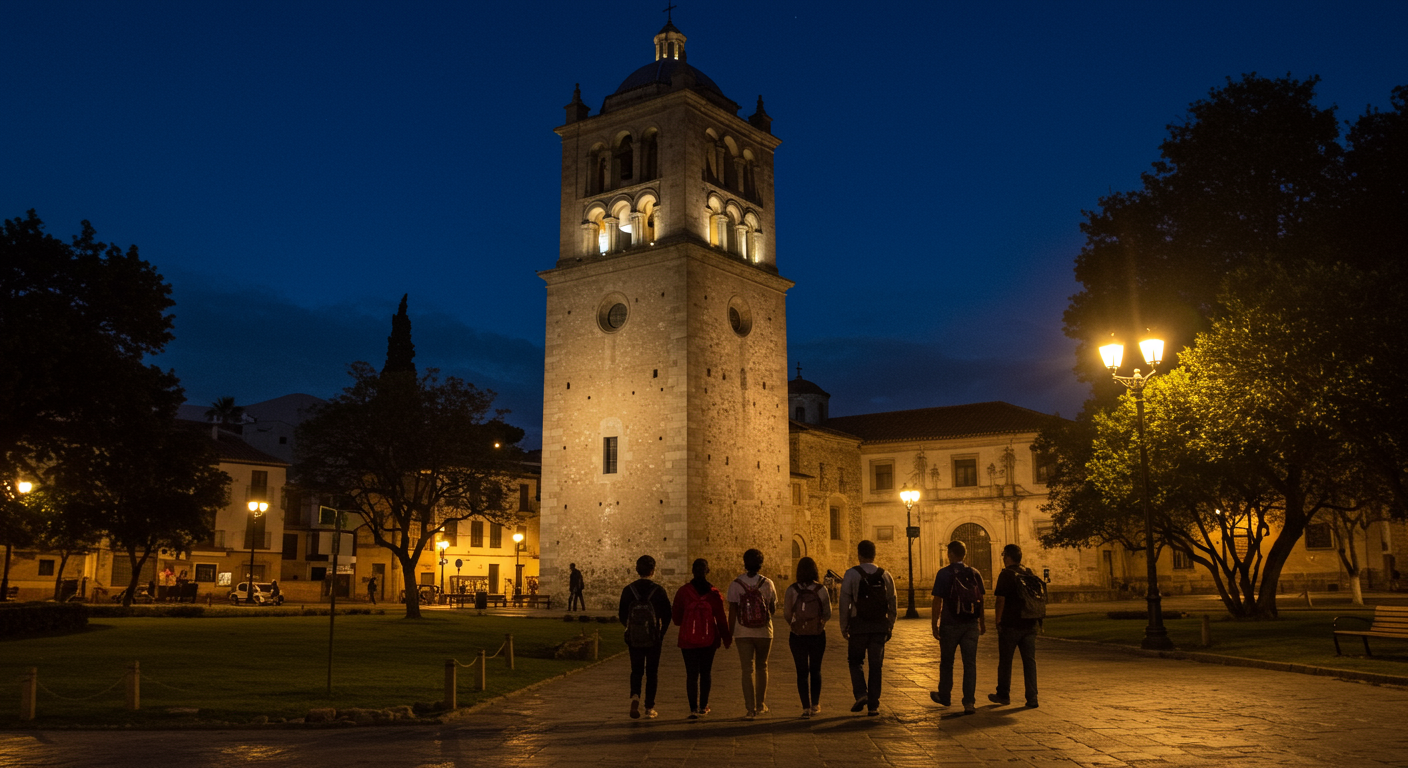
On a Saturday night in Cuenca, it does not take much for the city to feel theatrical. The air cools quickly after sunset. Church bells drift over the rooftops. The cobblestones seem to hold their shadows longer than modern streets do. By the time I joined a small crowd for the Ruta de Leyendas, it already felt like I had signed up for something halfway between a history walk, a neighborhood ritual, and a piece of street theater.
This is not a definitive guide to Cuenca's haunted past. It is better understood as a lived experience, the kind of evening that reveals as much about how a city remembers itself as it does about what can be proven. What I found on the Ruta de Leyendas was less a sequence of hard facts than a moving conversation among place, rumor, belief, and performance.
The gathering point: a tower with a dark reputation
The mood was set from the beginning. People spoke in low voices, half excited and half amused, as if everyone had agreed to suspend disbelief just enough to let the night work on them. The starting point carried a reputation tied to accusations of witchcraft and punishment, at least in the way guides and locals sometimes describe it. Whether every dramatic detail holds up under close historical scrutiny is another question, and it is worth keeping in mind. Still, beginning a night walk at a place associated with fear, judgment, and old stories gave the tour an immediate charge.
That tension became one of the most interesting parts of the experience for me. Cities often turn painful folklore and fragmentary history into shared storytelling. A tower is never just a tower once enough generations have attached warnings, whispers, and moral lessons to it. Standing there with strangers waiting for the first tale to begin, I was struck by how easily architecture can become stage scenery for a community's imagination.
What the Saturday night tour actually feels like
From a participant's perspective, the tour felt less like a horror attraction and more like a guided nighttime performance. The pacing was slow enough to absorb the atmosphere but steady enough to keep the suspense building. It was spooky in the way old cities are spooky: not because someone jumps out at you every five minutes, but because dim light, narrow streets, and a well-timed pause can make even an ordinary doorway feel loaded with meaning.
What stayed with me were the sensory details. The sound of footsteps on stone. Faces catching and losing the light as the group moved. A storyteller lowering their voice before a reveal. A corner turned at just the right moment. At times, the tour felt family-friendly, almost festive, especially when children or laughing couples were in the crowd. In other moments, it leaned into something more unsettling, when the stories brushed up against betrayal, punishment, religion, or death.
That balance is probably part of the appeal. You do not have to believe every legend literally to enjoy the effect. The route works because it uses the city itself as the special effect.
The legends that animate the route
I would not try to catalog every story told along the way, because part of the pleasure is hearing them unfold in sequence, attached to the actual spaces where they are said to belong. But a few stood out. Some centered on women accused, feared, or misunderstood. Others followed the familiar shape of colonial-era warnings: sin, secrecy, guilt, and punishment lingering in specific streets and buildings. There were stories that sounded like moral fables and others that felt more like rumors polished by repetition over time.
What makes these legends memorable is how firmly they are anchored to physical locations. A bridge is no longer just a bridge once it has inherited a tale of a doomed crossing. A plaza changes when it becomes the setting for an old warning repeated across generations. A doorway, balcony, or bell tower starts to feel like a witness. Cuenca itself becomes a character in the storytelling, not just the backdrop.
The blend is especially rich: folklore, superstition, colonial memory, religious symbolism, neighborhood gossip, and dramatic retelling. Even when I suspected a story had been embellished, I still found myself looking more carefully at the walls around me, as if they might confirm something the guide had left deliberately unresolved.
How history, myth, and performance blur together
That ambiguity is central to the experience. Some parts of the evening sounded grounded in documented episodes or long-standing local tradition. Other parts were plainly heightened for effect. I did not mind that. In fact, I think the blur between history and legend is exactly what gives a tour like this its energy.
At the same time, it is worth separating emotional truth from verified fact. Big claims about trials, exact dates, or named events deserve checking if they are going to be repeated as history rather than story. On the Ruta de Leyendas, though, factual precision did not seem to be the only point. The point was to show how cities remember through narrative, and how public memory often survives in forms less tidy than textbooks.
For expats and visitors, that creates a particular kind of experience. We arrive without inheriting the stories. We hear them as atmosphere, entertainment, and cultural texture. Locals may receive them differently, as fragments of something passed down, argued over, or folded into neighborhood identity. That difference matters. It reminds you that what feels like a charming ghost story to an outsider may carry deeper historical or emotional weight for someone else.
What surprised me most about the crowd
I expected mostly tourists. Instead, what struck me was how mixed the crowd felt. There were people who seemed to be on dates, families out for an evening walk, younger attendees treating it as a social plan, and visitors like me trying to understand the city through something more imaginative than a museum label. That mix changed the mood. It made the outing feel less like a niche attraction and more like a public ritual.
It also said something nice about Cuenca nightlife. Not every evening here has to revolve around dinner reservations or drinks. A city can offer shared storytelling as a night out, and people will come for it. In that sense, the tour felt revealing. It showed a version of urban life built around gathering, listening, walking, reacting together, and briefly seeing familiar places through a different lens.
Practical expectations for anyone thinking of going
If you are considering the Ruta de Leyendas, keep your expectations flexible and practical. Verify the current meeting point, start time, language, route, and ticketing details before you go, especially if you are planning around a specific Saturday night. If official information matters to you, confirm it directly rather than assuming schedules or starting locations never change.
Wear shoes you do not mind using on uneven streets. Bring a layer, because Cuenca evenings can cool off quickly. If you are sensitive to altitude or long walks, pace yourself. And if you are traveling with children, the experience will probably depend on their age and tolerance for suspense. Much of the fun comes from mood rather than outright scares, but some stories and settings may still feel intense for easily spooked listeners.
It is also the kind of outing best enjoyed with the right mindset. Go for atmosphere, storytelling, and a chance to see the city after dark. Go less for airtight historical certainty.
Why this kind of night out matters in an expat life
One of the quieter challenges of expat life is how easy it is to know a city only through practicalities: where to pay a bill, where to buy produce, which café has reliable Wi-Fi, which neighborhood feels most convenient. Those things matter, of course. But they do not necessarily make a place feel inhabited in the deeper sense.
A night like this helps. Even when the facts behind a legend remain partly contested or theatricalized, the stories still open a door into local imagination. They show what a city fears, repeats, laughs about, warns against, and chooses to remember. For me, that was the real value of the Ruta de Leyendas. It made Cuenca feel less like a map of useful places and more like a place with layers of voice and memory.
By the time the tour ended and people drifted off into the night, the streets looked the same as before, but not quite. A plaza felt more charged. A tower seemed less decorative. A familiar block held onto a new shadow. That may be the best kind of ghost-tour result: not that it convinces you of the supernatural, but that it teaches you to look at a city twice.