In Ecuador's Hollowed-Out Gold Town of Zaruma, Miners Still Fear El Muki and a Phantom Gold Train
In Ecuador's Hollowed-Out Gold Town of Zaruma, Miners Still Fear El Muki and a Phantom Gold Train
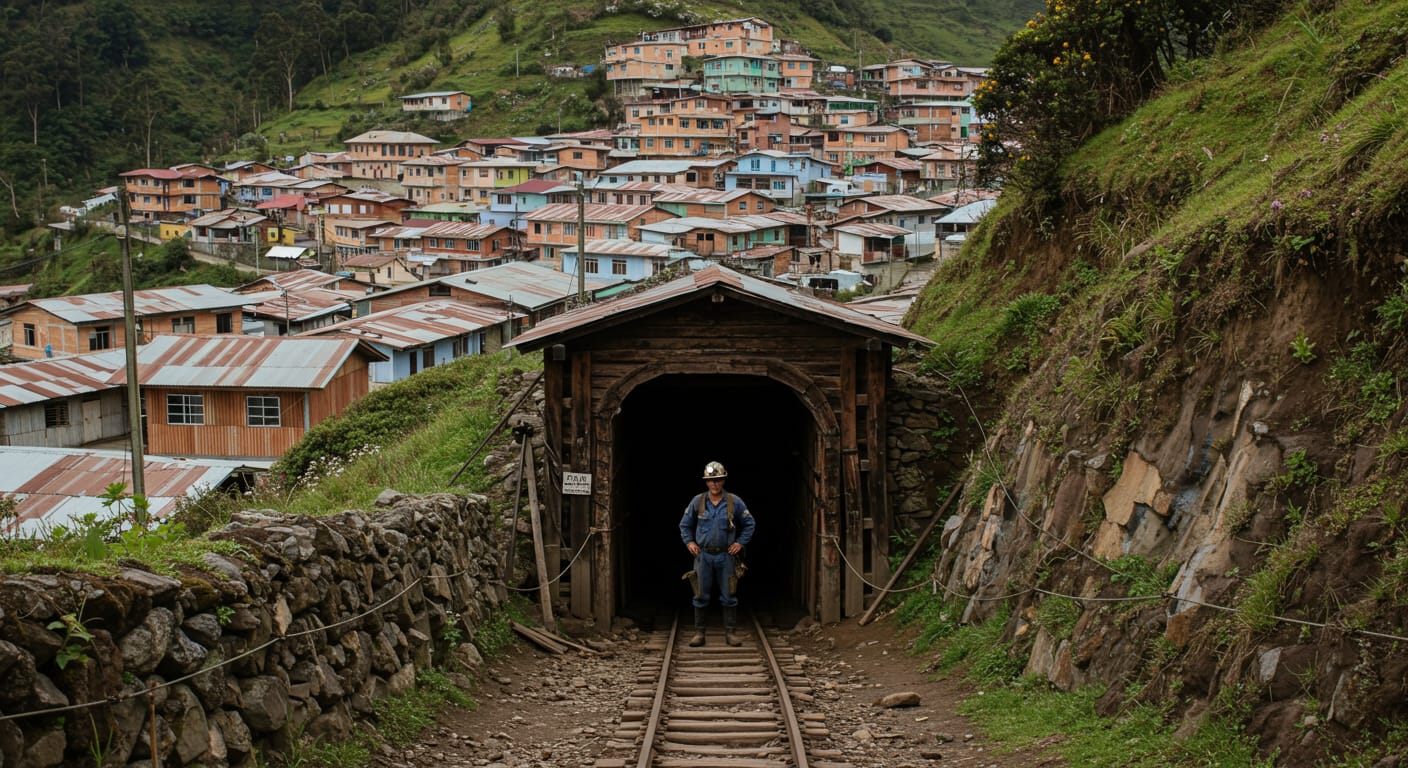
In the hills of El Oro province, in southern Ecuador, the town of Zaruma sits atop something few of its residents can see but nearly all of them live with: centuries of mine tunnels honeycombing the ground beneath their homes. Zaruma is not a metaphorical mining town. It is, in a very literal sense, a town built on top of a mine — one whose wealth shaped its streets and whose emptiness now shapes its anxieties.
A Town Built on Tunnels
Zaruma's colonial-era buildings, with their wooden balconies and steep tiled roofs, climb a hillside that has been excavated from within for generations. The architecture itself tells the story of a town that grew upward and outward while its foundations were quietly hollowed from below.
This layered history has left Zaruma with an ongoing, generally understood concern: that mining activity beneath residential areas can contribute to land subsidence and structural instability. Cracks in walls, uneven streets, and shifting foundations are the kind of everyday realities that residents and local observers describe as part of living in a town shaped by what lies underneath it, even without pointing to any single documented incident.
Gold in the Blood: A Living Mining Culture
Zaruma's identity as a gold-mining hub stretches back generations, long enough that mining is less an industry here than an inheritance. The town's name is inseparable from gold, and its economy has been built and rebuilt around it for centuries.
That history is not confined to the past. Artisanal and small-scale mining continues in and around Zaruma today, carried out by individuals and small operations working tunnels old and new. For many residents, this work remains an economic lifeline — one that also carries daily risk, given the informal conditions and unstable ground in which much of it takes place.
El Muki: The Spirit of the Mines
Underground, where sunlight never reaches and danger is a constant companion, miners across the Andes have long kept alive belief in figures like El Muki, a mining-spirit character rooted in broader Andean folklore. Depending on the telling, El Muki appears as a guardian of the tunnels, a trickster who misleads careless miners, or an omen whose appearance signals fortune or disaster to come.
El Muki's presence in Ecuadorian mining lore is best understood as part of a shared regional mythology rather than a confirmed, uniquely local Zaruma legend — the figure is more strongly documented in the mining traditions of Peru and Bolivia. Still, similar spirit-guardian beliefs have traveled along the Andes' mining routes for generations, and it's easy to understand why. In dark, unstable tunnels where a misstep can be fatal, superstition and survival have always been close companions. Believing in something watching over — or testing — those who go underground gives shape to fears that would otherwise remain formless.
The Phantom Gold Train
Alongside tales of underground spirits, Zaruma carries local legends of a ghostly train said to have once hauled gold out of the region under cover of night. Descriptions vary, but the core of the story remains consistent: a train that appears and vanishes, echoing the movement of wealth out of the town and into the wider world.
The legend connects directly to Zaruma's historical role in gold export, when transport infrastructure was built specifically to move the region's mineral wealth toward ports and markets beyond. Whether or not any single phantom-train sighting can be traced to a specific event, the story functions as folklore often does: preserving the memory of an economic and industrial past that shaped the town long after the physical infrastructure faded from daily use.
Heritage, Memory, and the Weight of Gold
Zaruma's colonial architecture and broader cultural significance are frequently cited as part of what makes the town distinctive, though any specific heritage recognition or formal designation should be treated cautiously pending verification rather than assumed.
What is clearer is the way folklore and physical instability seem to mirror one another in Zaruma. A town literally hollowed out by centuries of tunneling has also become, in its stories, figuratively haunted by that same extraction — by spirits said to guard what's taken from the earth, and by trains said to carry away what the town gave up to build itself.
For those drawn to places where history, myth, and everyday risk share the same ground, Zaruma remains a singular destination: a town where the wealth that built it and the emptiness it left behind continue to define daily life, both above and below the surface.