Guagua Auca: The Unbaptized Baby Ghost That Haunts Ecuador's Andean Roads
Guagua Auca: The Unbaptized Baby Ghost That Haunts Ecuador's Andean Roads
The Crying Child on the Mountain Road
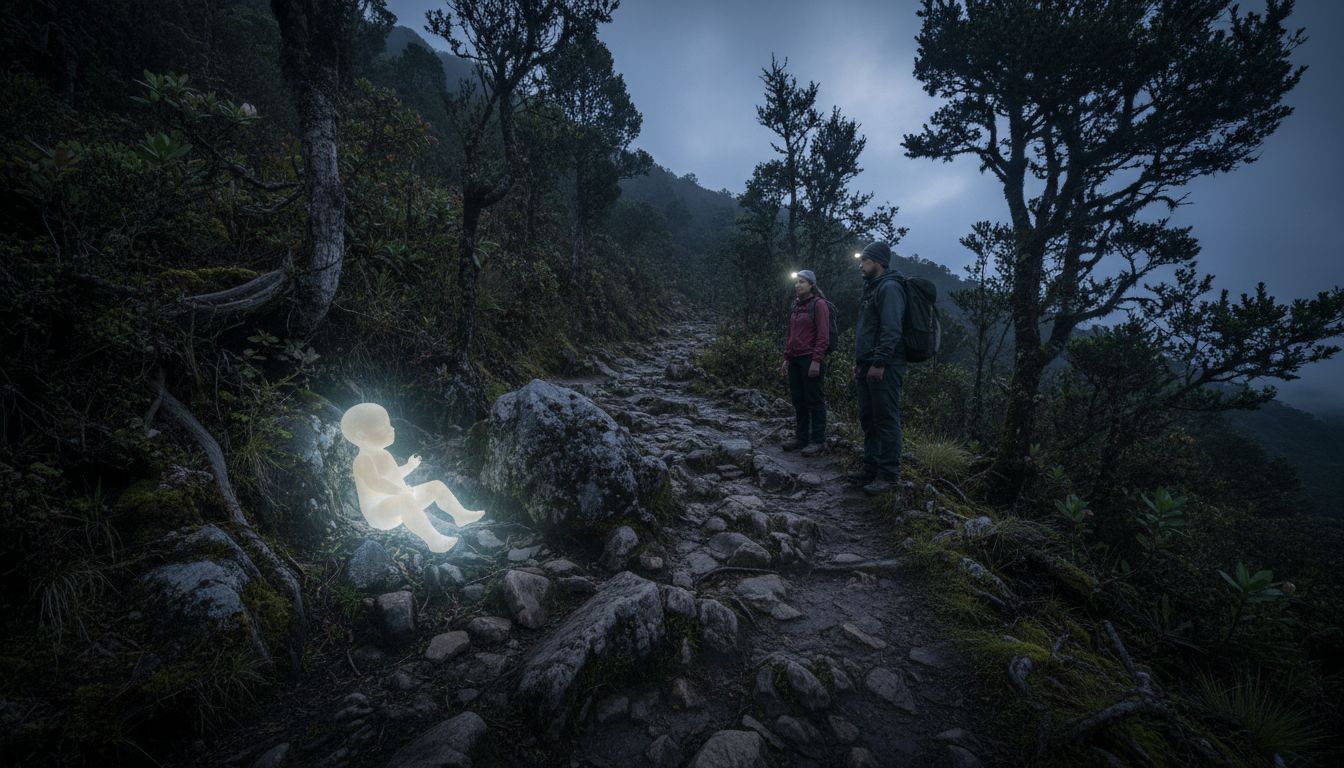
The dirt path winds between stands of eucalyptus, barely visible under a sky thick with stars. A man walks home alone, unsteady after a long night at a neighbor's gathering, the kind of walk that stretches a short distance into an hour. Somewhere in the hills around Ecuador's rural highlands, stories like this one have been told for generations, and they tend to begin the same way: with a sound that should not be there. A baby's cry, thin and insistent, drifting out of the darkness where no house or farm sits for miles.
In these tales, the isolation of the Andean countryside is not incidental—it is the entire stage. Narrow paths between villages, the absence of streetlights, the particular hush of highland nights all set the scene for an encounter that, according to oral tradition, almost never ends well for the traveler. The figure at the center of this story goes by many names, but one of the most enduring is the Guagua Auca. What exactly happens when someone stops to help that crying child is a detail the legend saves for later—and it is rarely a happy ending.
What Is the Guagua Auca?
The name itself offers a window into the story's origins. "Guagua" comes from Kichwa, the indigenous language spoken across much of Ecuador's highlands, and simply means "child" or "baby." "Auca," meanwhile, carries a heavier set of meanings—commonly translated as "wild," "savage," or, in some tellings, "unbaptized" or "pagan." Put together, Guagua Auca points toward something unsettling: a child who exists outside the bounds of civilization and ritual completion.
At its core, the legend describes the restless spirit of an infant who died before being baptized, doomed to wander the earth rather than pass peacefully into the afterlife. As with most orally transmitted folklore, there is no single authoritative version. Some communities refer to the figure as Huahua Auca, a close linguistic variant, and details shift from valley to valley—how the spirit appears, what provokes its transformation, and what becomes of its victims. This variability is not a flaw in the tradition; it is characteristic of how such stories live and adapt across generations and geography.
Baptism, Original Sin, and the Unbaptized Soul
To understand why an unbaptized infant became the center of such a potent piece of folklore, it helps to look at the Catholic doctrine that Spanish colonization brought to the Andes. Catholic teaching historically held that infants who died without baptism could not enter heaven, instead existing in a theological holding place often referred to as limbo—neither condemned nor fully saved. This doctrine placed enormous spiritual weight on the timing and performance of baptismal rites, particularly in contexts where infant mortality was common and access to clergy was not guaranteed.
When this doctrine arrived in the Andes, it did not simply replace existing indigenous cosmologies—it merged with them. Andean belief systems already held complex understandings of spirits, ancestors, and the natural world's porousness between the living and the dead. The result of this syncretism was a new kind of anxiety, one specific to the colonial and postcolonial Andes: the fear that a child who died before baptism was not simply unresolved in a doctrinal sense, but was actively present, wandering, incomplete, and potentially dangerous.
This pattern echoes across Latin American folklore more broadly. Many observers note the structural similarities between the Guagua Auca and other "unresolved soul" legends, such as La Llorona, the weeping woman said to roam searching for her lost children. Both figures emerge from a shared cultural logic: that certain deaths—especially those involving children, grief, or incomplete ritual—leave behind spirits that cannot rest and that intrude upon the world of the living.
The Trap: How the Legend Unfolds
Across tellings, the narrative structure of the Guagua Auca story tends to follow a recognizable arc. A lone traveler, walking at night, encounters what appears to be an abandoned infant crying on the path. The sound is designed—within the logic of the story—to trigger an instinctive, compassionate response: someone hears a baby in distress and moves to help.
A recurring detail in these accounts is the specific vulnerability of the protagonist: nearly always a man returning home late, and nearly always one who has been drinking. This is not incidental to the story's function, a point explored further below. The traveler, moved by the cries or perhaps simply curious, approaches and picks up the child—and this is the moment the story turns. What was an infant becomes, in the retelling, something else entirely: a demonic or monstrous presence, its true nature finally revealed now that it has made contact with its target.
The outcomes described in these tales vary, but they share a common register of dread. Some versions describe the victim fleeing in terror, pursued through the dark. Others describe direct attack or harm. Still others leave the fate of the traveler ambiguous, emphasizing instead the lingering psychological toll—the fear that follows anyone who has had, or believes they have had, such an encounter.
A Cautionary Tale With a Purpose
Folklore scholars and cultural observers frequently point to the practical social function embedded in legends like this one. A story warning that solitary, intoxicated night travel might end in a supernatural attack serves an obvious community purpose: it discourages exactly that behavior. In rural communities where formal law enforcement or emergency services might be distant or unavailable, fear-based narratives have long served as a kind of informal social regulation—keeping people, and particularly men prone to drinking, closer to home after dark.
This moralizing function is not unique to the Guagua Auca. Andean and broader Latin American oral traditions are rich with supernatural tales that double as behavioral warnings, told to children and adults alike. Whether the message concerns the dangers of wandering alone, the consequences of excessive drinking, or the importance of completing religious obligations, these stories blend entertainment, fear, and social instruction into a single enduring package.
Living Folklore in the Andes Today
Whether the Guagua Auca remains a living part of belief and storytelling in contemporary rural Ecuador is harder to pin down with confidence. Oral traditions like this one are notoriously difficult to document comprehensively—they shift by community, are rarely written down in standardized form, and depend heavily on the willingness of local storytellers to share them with outsiders. A recurring concern among researchers documenting folklore of this kind is the risk of flattening rich, locally specific variations into a single generic narrative, which is why firsthand ethnographic verification from highland communities remains valuable and, in many cases, still needed.
For expats and travelers spending time in Ecuador's highlands, encountering a story like the Guagua Auca often happens informally—through a conversation with a local host, a comment made half-jokingly after dark, or a story shared around a fire in a rural community. These encounters, however casual, offer a genuine window into the layered belief systems that shaped—and continue to shape—Andean culture, where Catholic doctrine and indigenous cosmology remain intertwined centuries after their first collision.
The enduring appeal of the Guagua Auca lies precisely in this complexity. It is at once a ghost story, a moral lesson, and a piece of living cultural history—a small but telling example of how belief systems adapt, merge, and persist across generations in Ecuador's Andean communities.