Fire on Taita Imbabura: What It Means When a Sacred Mountain Burns
Fire on Taita Imbabura: What It Means When a Sacred Mountain Burns
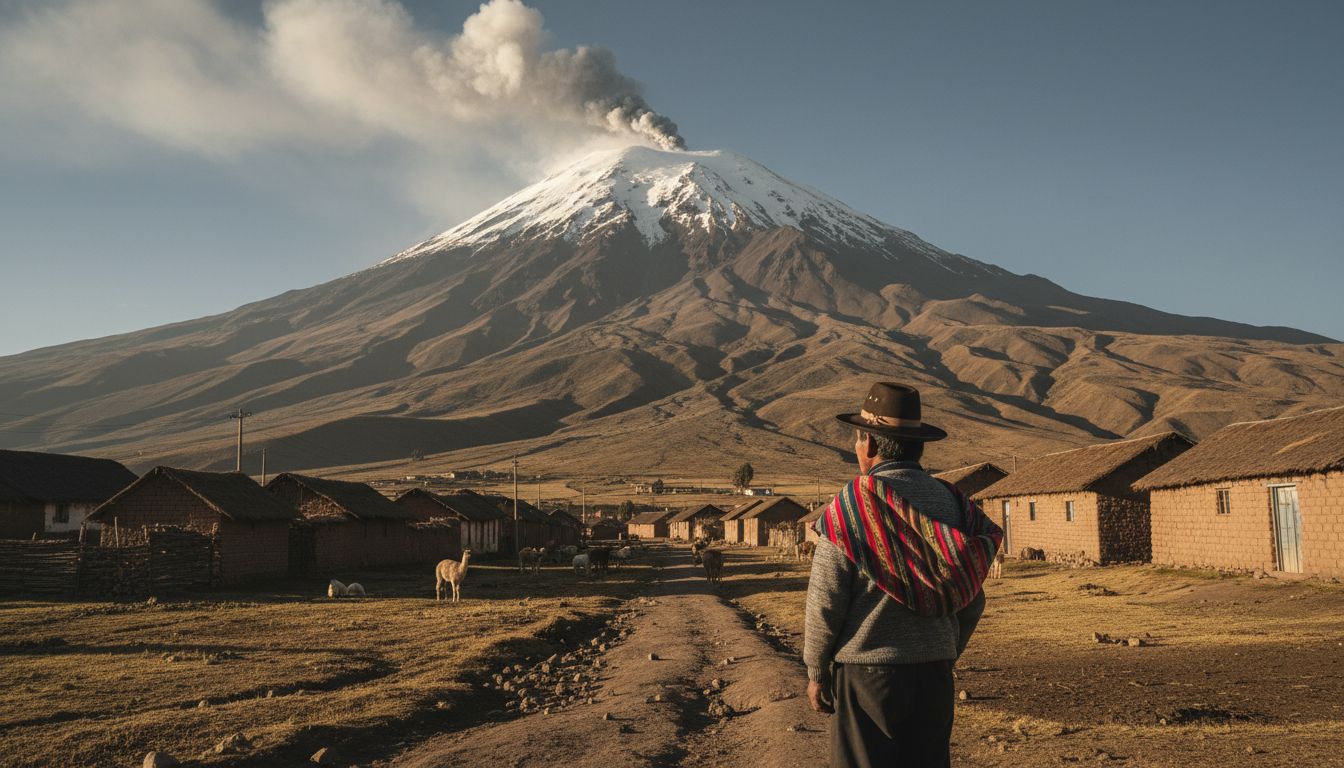
From certain vantage points in the Imbabura province, the volcano dominates the horizon so completely that it becomes part of daily rhythm rather than scenery. Recent reports describe fire moving across sections of Imbabura's slopes, visible from towns and rural roads below. It's worth saying plainly at the outset: the specific details of this fire event, including its exact timing, cause, scale, and any official response, remain unconfirmed and unverified. This piece does not attempt to report those facts. Instead, it's a reflection on what such an image means culturally to the communities who have long understood this mountain as something closer to family than to geology.
Taita Imbabura: The Father Who Watches Over the Valley
In Kichwa-Otavalo oral tradition, Imbabura is not simply a landform. He is Taita Imbabura, a masculine, paternal presence spoken of as husband and father. Many local narratives describe the mountain as an active participant in the life of the valley, one who watches, responds, and occasionally shows temperament through weather, mist, or rumbling. This is not a metaphor deployed for tourists; it reflects a living relational worldview in which the land itself has agency, memory, and personality.
This framing shapes everyday life in visible ways. Elders reference the mountain's moods when explaining shifts in weather. Decisions about planting, harvest timing, and even community gatherings are sometimes discussed in relation to how Taita Imbabura appears that season, whether shrouded in cloud or standing clear. The mountain is a presence to be respected, consulted in spirit, and never taken for granted.
Mama Cotacachi and the Marriage of Two Volcanoes
Across the valley stands Cotacachi, known in the same tradition as Mama Cotacachi, understood as Imbabura's wife. The pairing of these two volcanoes as husband and wife is one of the most enduring pieces of Andean cosmovision in the region. Oral traditions describe seasonal exchanges between the two peaks, with mist or cloud sometimes interpreted as visits between them, and changes in visibility read as signs of their relationship.
These stories fit a broader Andean pattern in which landscape features are gendered and related to one another much like a family or community. Mountains are not isolated monuments but nodes in a web of relationships, echoing human bonds of marriage, kinship, and mutual responsibility. Mama Cotacachi and Taita Imbabura, in this sense, model a relational way of understanding land itself, one where geography and social meaning are inseparable.
When the Sacred Landscape Burns
For communities who understand Imbabura as a father figure, the image of fire on his slopes carries a weight that goes beyond ecological concern. It resonates as something closer to witnessing a family member in distress. This symbolic layer doesn't require verified details about the fire's cause or extent to carry meaning; the emotional and cultural resonance exists independent of those facts.
It is true that, more broadly, páramo and high-slope fires in Andean regions have become a recurring seasonal concern during dry periods, a pattern many observers in the region have noted in recent years. This is offered here only as general background, not as a sourced claim about the specific fire referenced in current reports. What can be said with more confidence is the emotional undertone: for those who hold Taita Imbabura as an ancestral figure, any sign of the mountain burning invites reflection on vulnerability, memory, and care.
An Outsider's View: Watching Reverence Meet Risk
Watching this unfold as an outsider living in the region offers a particular kind of lesson. A Western environmental lens tends to frame a mountain fire primarily in terms of ecology, statistics, and policy: acreage affected, response times, prevention strategies. That framing isn't wrong, but it can feel incomplete when standing among neighbors who speak of the mountain with the tenderness reserved for elders.
What becomes clear is that the Indigenous relational cosmovision toward Imbabura and Cotacachi is not a quaint cultural detail layered on top of "real" geological facts. It is a different, equally coherent way of knowing the land, built on relationship rather than extraction or observation alone. For expats, this is often the first real lesson in humility: understanding that belonging in a place like the Imbabura valley means learning to listen to how communities narrate their own landscape, rather than importing outside frameworks as though they were the only valid lens.
What Remains When the Smoke Clears
Whatever the eventual, verified facts of this particular fire turn out to be, the deeper story of Taita Imbabura is unlikely to be diminished by it. Cultural memory has a way of absorbing hardship into narrative, and mountains long understood as father and husband tend to remain so, reinterpreted rather than erased by each new generation.
Imbabura's story will likely keep being told around kitchen tables and in classrooms, carried forward by people who see in the mountain not just a physical feature but a relative worth protecting. For those living nearby, whether born to the tradition or arrived from elsewhere, the invitation seems to be the same: to treat land as something held in relationship, not simply used, and to let that sense of stewardship guide how the story continues from here.