El Cajas and the Campfire Rumor of Lights in the Sky
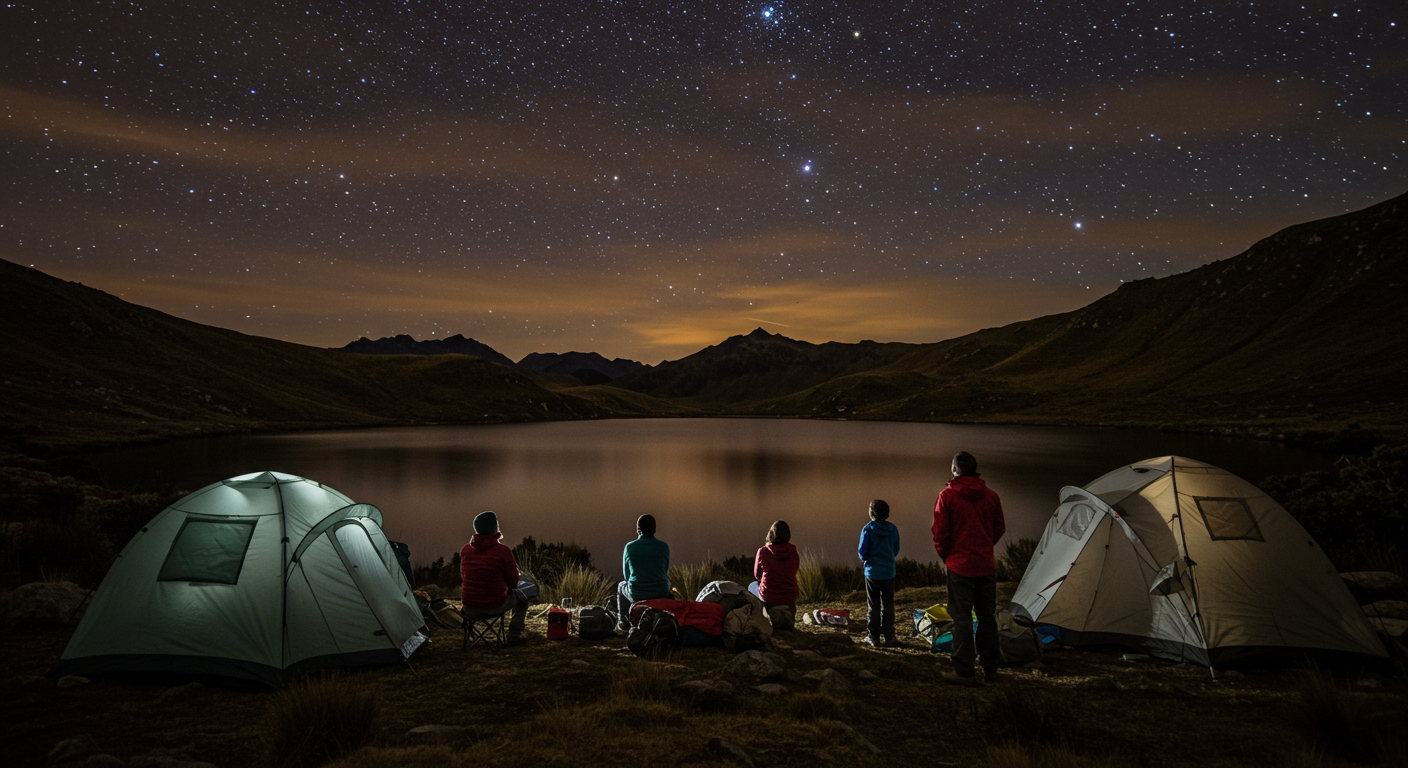
Some places seem to invite stories the moment you arrive. For many travelers, El Cajas has that quality. The landscape feels stripped down to essentials: cold wind, dark water, rough grass, sudden silence, and a sky that seems wider than it should be. By late afternoon, the light turns thin and metallic. As evening settles over the lakes, even ordinary shadows can feel charged with possibility.
Among some campers and curious visitors, that atmosphere has helped give El Cajas a growing reputation as a place to watch for unexplained lights. It is not an official title or an established fact, just the kind of nickname remote places pick up when enough people come back with a story. Around camp stoves and shared thermoses, the idea gets repeated: if you want to sit in the cold and look for something strange over the water, this is the place.
Why El Cajas Feels Like the Perfect Place for a UFO Story
The appeal is easy to understand, even for skeptics. Isolation sharpens attention. Darkness removes context. Distance becomes harder to judge. A single light can seem much closer, stranger, or more intentional than it might in daylight. In a bleak and beautiful landscape, the mind starts searching for patterns.
That is part of why UFO talk fits so naturally here. The setting does half the work. A camper only has to point across a lake and ask, “Did you see that?” and suddenly everyone is staring at the same patch of black sky. Whether the source turns out to be ordinary or not almost becomes secondary. The mood has already taken hold.
A Night at Camp: Waiting for Lights Over the Water
Evening at camp tends to follow a familiar rhythm. People hurry through setup before the cold deepens. Conversation comes in bursts, then slows. Someone zips up a jacket and steps away from the tents to stare at the horizon. Someone else says they saw a flash over the water a few minutes earlier. Another person insists it was probably a reflection. Nobody sounds completely convinced.
Then comes the waiting. Long stretches of it. Breath visible in the dark. Hands wrapped around something hot. Eyes adjusting, then second-guessing themselves. Campers scan ridgelines and open sky, trading rumors they heard from a friend, a guide, another traveler, another late-night fire circle. The stories do not need to match to be effective. One person mentions hovering lights. Another remembers something darting sideways. Another swears the strangest part was not the light itself, but how silent everything felt right before it appeared.
In these moments, the experience is less about evidence than about collective attention. Everyone is looking up together, and every flicker becomes a small event.
How a Landscape Turns Into Local Lore
Remote places often gather mythology because they leave room for imagination. Travelers arrive primed for discovery. Hikers want a story worth retelling. Expats, especially, can be drawn to the feeling that they are still uncovering corners of life that have not been flattened into standard tourism. A dramatic place with a little uncertainty around it quickly becomes memorable.
That is how lore forms. A few unusual nights become repeated anecdotes. Repeated anecdotes turn into expectations. Expectations shape what people notice, and what they notice becomes the next story. Social media can accelerate the process, but old-fashioned word of mouth may matter even more. One campsite conversation is enough to send the next group out looking at the sky with a different kind of attention.
The mystery itself becomes part of the destination. People may come for scenery, solitude, or a night outdoors, but they stay alert for the possibility that something else might happen. Even when nothing does, the tension between the ordinary and the uncanny gives the place a distinct personality.
What Campers Say They See
The reports, as they are told, tend to fall into familiar categories. Some describe distant lights that seem to hover longer than expected. Others talk about flashes that appear and vanish before anyone else can confirm them. Some mention movement that seems odd against the dark backdrop of water and hills. In campfire retellings, small details become important: a pause, a change of direction, a light reflected where it should not have been.
At the same time, there are plenty of non-extraordinary possibilities. Headlights seen from far away can distort in darkness. Reflections off water can mislead the eye. Stars and planets near the horizon often appear to shimmer or shift. Weather and atmosphere can make motion seem stranger than it is. Fatigue, cold, and expectation can heighten perception too.
That balance is what keeps the story interesting. The lights, whatever their source, are only part of it. The rest lies in how people interpret what they think they saw, and how quickly a private impression becomes a shared narrative.
Why Expats and Travelers Are Drawn to This Kind of Place
For many expats and long-term travelers, the attraction is not just the possibility of seeing something unexplained. It is the chance to step outside routine and into an experience that feels vivid, a little uncomfortable, and hard to summarize neatly afterward. A cold night in a remote landscape offers that in a way polished attractions rarely do.
There is a social appeal, too. Uncertainty creates instant community. Strangers who might otherwise exchange only a few polite words suddenly find themselves comparing sightings, debating explanations, and laughing at how quickly everyone became an amateur sky watcher. By morning, the group may still disagree about what happened, but they have a story in common.
That may be the real pull of places like El Cajas. You do not have to prove anything for the night to matter. It is enough that the darkness felt deep, the lakes looked otherworldly, and for an hour or two everyone at camp was willing to believe the sky might offer a surprise.
The Mystery Matters More Than the Answer
Places gain identity through the stories people attach to them. Some stories are historical, some practical, some wildly speculative. The UFO-watching reputation that some travelers talk about in El Cajas belongs to that last category: part rumor, part atmosphere, part sincere testimony, part wishful thinking. It survives because it fits the landscape so well.
Skepticism and wonder can coexist comfortably here. In fact, they probably need each other. Too much certainty, in either direction, would flatten the experience. Better to leave room for both the logical explanation and the unexplained impression, for the camper who shrugs and the camper who keeps staring at the ridge long after everyone else has gone to bed.
In the end, what people carry home may not be proof of anything unusual. It may simply be the memory of cold lakes, a black sky, a restless wind, and that enduring human urge to look up into the dark and imagine that the world still holds a few secrets.