Ecuador Swears to Its Flag on September 26, and Every Senior Class Picks Its Abanderado
Ecuador Swears to Its Flag on September 26, and Every Senior Class Picks Its Abanderado
A Ceremony I Didn't See Coming
I first noticed something was different when the seamstress down the street had a line of parents outside her door, all clutching swatches of navy and white fabric. It was late September, and I had no idea what was coming. A neighbor mentioned, almost in passing, that her daughter had been chosen as an escolta this year, and that the whole family was scrambling to prepare. I nodded along, pretending to understand, then went home and started asking questions.
That's how I learned about September 26—a date that, as far as I can tell, lives somewhere in the marrow of most Ecuadorians, taught early and remembered often. Yet in my time here, I'd never once heard an expat mention it. It felt like stumbling onto a national holiday hiding in plain sight.
What follows is my attempt to make sense of it: part civic history, part school tradition, and part meditation on what it's like to watch a country's values play out on a school field, one flag at a time.
What Actually Happens on September 26
The occasion is the Juramento a la Bandera, or Oath to the Flag, and it traces back to the Battle of Tarqui in 1829, a military engagement tied to Ecuador's early independence struggles against Gran Colombia. Over time, the date has been folded into the national calendar not just as a historical footnote, but as a living ritual observed in schools across the country.
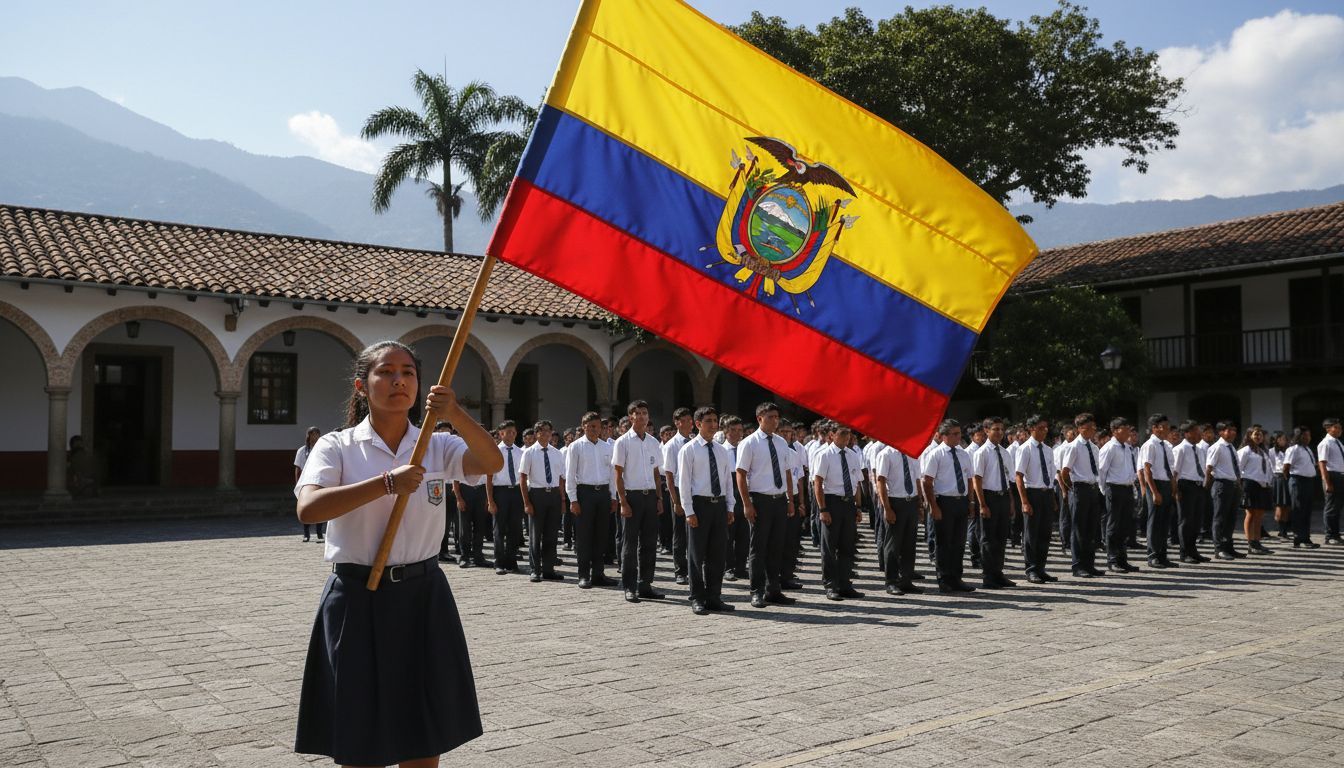
On the day itself, campuses shift into a kind of civic solemnity you don't often see elsewhere. Students arrive in their most formal uniforms, sometimes with white gloves or sashes. Assemblies are held outdoors when possible, with rows of students standing at attention while the national anthem plays and the flag is raised. There's a formality to the proceedings that surprised me—less pep rally, more state ceremony, even at the level of a single school.
What struck me most was the blend of genuine patriotism with a kind of pageantry. It isn't ironic or performative in the way some civic rituals can feel; it seems to matter to the people participating in it, from the youngest students to the administrators overseeing the event.
The Abanderado: Ecuador's Answer to Valedictorian
At the center of each school's ceremony is the abanderado, the student chosen to carry the national flag. Unlike a popularity contest or a rotating honor, the role is typically earned through academic ranking—the student with the highest overall grades in the graduating class takes the position, a kind of valedictorian crossed with a ceremonial guard of honor.
Supporting the abanderado are the escoltas, usually the next-highest-ranked students, who carry the school flag and, in many cases, a provincial flag as well. Together, this trio becomes the visual centerpiece of the ceremony, walking in formation, standing at the front during the anthem, and often reappearing at other civic events throughout the year.
The symbolic weight of the honor within the school community seems hard to overstate. Parents speak of it with real pride, and the selection is treated as a meaningful marker of a student's years of effort—not unlike how a valedictorian speech might function in an American high school, but with more visible, repeated ceremonial presence throughout the year.
Pride, Pressure, and a Little Controversy
Where there is ranking, there is, inevitably, some tension. From conversations with local parents, it's clear that the process of determining who becomes abanderado or escolta can stir up quiet competition—and sometimes not-so-quiet disagreement. A recurring theme in these conversations is how closely families track academic standing, sometimes down to fractions of a grade point, in the run-up to the announcement.
One parent described, half-laughing and half-serious, how the ranking had become a topic of dinner-table debate for weeks. Many observers note that the intensity around the selection says something about how seriously merit and academic achievement are woven into the culture—not just as personal accomplishment, but as something the whole family shares in, for better or worse.
It's a reminder that traditions carrying deep pride often carry pressure in equal measure, and that the line between the two can be hard to see from the outside.
Watching as an Outsider, Feeling Like a Neighbor
I ended up attending a ceremony at a local school as a guest, invited by the same neighbor whose daughter was serving as escolta. Standing at the edge of the schoolyard, I watched the students file in—crisp uniforms, sashes catching the morning light, a hush falling over the crowd as the anthem began.
There was something quietly moving about it: the seriousness on the students' faces, the way parents leaned forward slightly as their children passed, the collective intake of breath when the flag was finally raised. I didn't grow up with this ritual, and I felt that distance in the moment—an awareness that I was witnessing something with a history and meaning I could only partially access.
But there were also moments of connection. A shared laugh with a stranger nearby when a gust of wind nearly took someone's hat. A nod of recognition from my neighbor across the crowd. It felt less like observing a foreign custom and more like being let in, briefly, on something that mattered to the people around me.
Flags, Pledges, and Prom Courts: A Cultural Mirror
It's hard not to draw comparisons to civic-school rituals from home—the daily pledge of allegiance recited half-consciously by students barely out of bed, the valedictorian speech tucked into a graduation ceremony otherwise dominated by pomp and photography, the homecoming court elected more for popularity than performance.
What stands out in the Ecuadorian version is how directly patriotism and academic merit are braided together, and how visible that braid remains throughout the school year rather than being confined to a single day. The abanderado isn't just crowned once and forgotten; the role carries forward, a living symbol of achievement tied explicitly to national identity.
The contrast highlights something particular about how each culture chooses to connect youth, education, and civic pride—and watching it unfold here has made me look differently at the rituals I once took for granted back home.
What This Tradition Taught Me About Belonging
Watching the Juramento a la Bandera shifted something in how I think about community here. It's easy, as an expat, to experience a country mostly through its landscapes, its food, its pace of life. This ceremony offered something different: a glimpse into how a nation teaches its children to feel connected to it, formally and repeatedly, from a young age.
I think about what it might mean to raise a child inside this tradition—to grow up with the expectation that academic effort might be rewarded not just with a grade, but with the honor of carrying your school's flag in front of the whole community. It's a different relationship to merit and pride than the one I grew up with.
I don't know that I'll ever fully belong to this ritual the way the families around me do. But standing at the edge of that schoolyard, listening to the anthem rise over rows of students in white gloves, I felt closer to understanding what belonging here might actually mean.