Did Newly Found Music Archives Really Prove Cantuña Was Real? A Quito Legend Meets the Historical Record
If you live in Quito long enough, you eventually hear the story of Cantuña. It usually comes attached to a church wall, a plaza, or a dramatic retelling from someone clearly enjoying the chance to introduce a newcomer to one of the city’s most enduring legends. Cantuña is not just a figure from folklore. He is part of how Quito explains itself: devout, theatrical, layered, and never entirely separate from the supernatural.
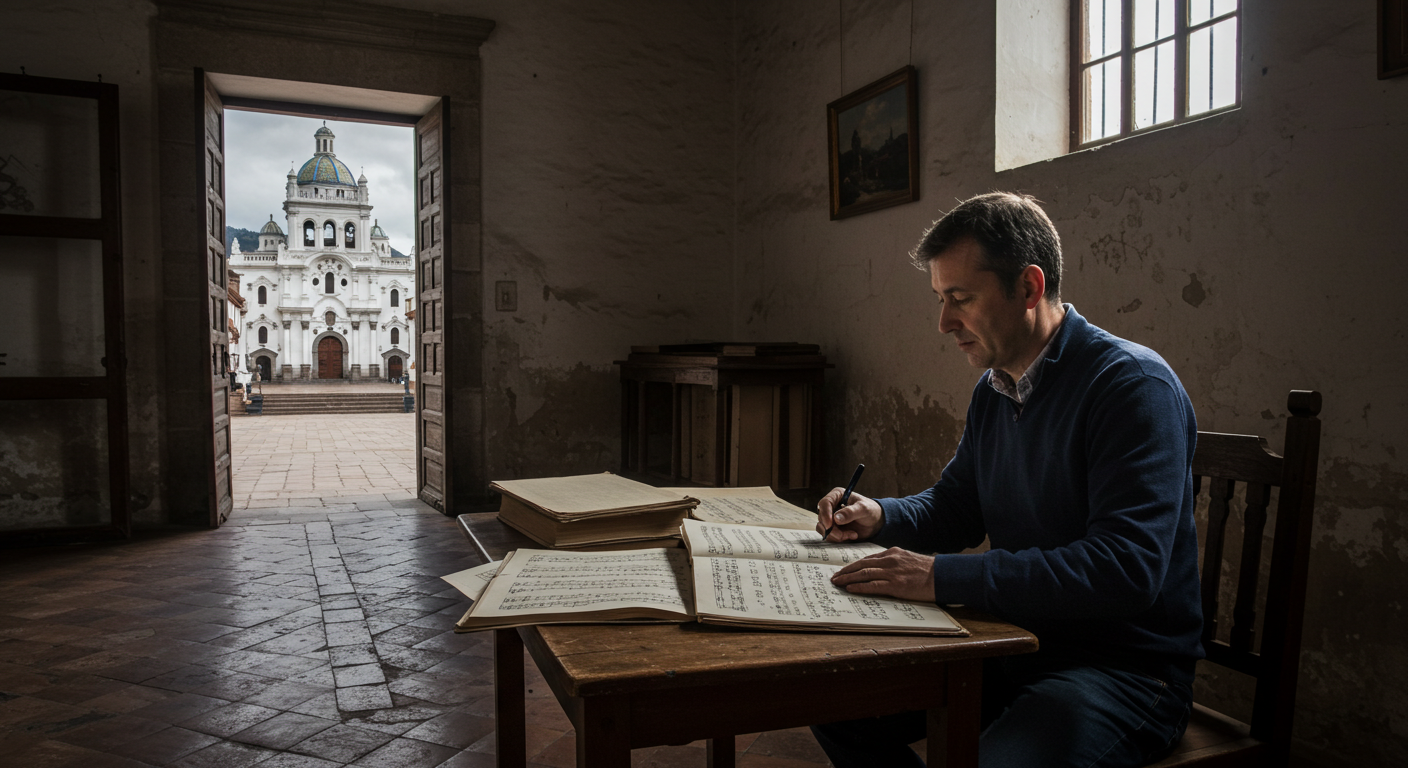
Now there is an intriguing twist to that familiar tale. Reports have circulated that a musicologist found 17th-century musical scores linked to the name Cantuña, raising the possibility that the legendary builder may have been based on a real historical person. That possibility is fascinating, but it is not the same as closing the case. For now, the most careful reading is that archival material may narrow the distance between folklore and history, not erase it.
Why Cantuña Still Haunts Quito
The version most people hear first is unforgettable. Cantuña, often described as an Indigenous or mestizo builder, is given an impossible deadline to complete work connected to a church. Desperate, he makes a pact with the devil, who agrees to help finish the job in exchange for his soul. But Cantuña outsmarts the deal. By leaving one stone unfinished, he ensures the work is not truly complete, and the devil loses his claim.
It is exactly the kind of story that survives for centuries because it works on several levels at once. It is suspenseful and moralizing, but it is also about labor, social hierarchy, colonial pressure, and intelligence used as a form of resistance. In Quito, the legend endures not only because it is dramatic, but because it expresses something recognizable about survival in a world shaped by power and faith.
The Legend Expats Hear First
For expats, Cantuña is often an early lesson in how cities like Quito tell their history. Official dates, church facades, and guided tours matter, but so do the stories locals pass down with a straight face and a half-smile. In that sense, Cantuña is a gateway figure. He helps outsiders understand that in Quito, folklore is not a decorative extra added to history. It is one of the main ways history is remembered and felt.
The appeal of the tale also lies in its ambiguity. Is Cantuña a moral warning, a folk hero, a symbol of colonial exploitation, or a clever local trickster who beats impossible odds? He can be all of those things at once. That flexibility helps explain why the legend has remained alive in the city’s imagination.
What the Reported Discovery Actually Suggests
The newer claim, as it has been described, is that 17th-century musical scores may contain references connecting the name Cantuña to a real person in colonial Quito. If true, that would be significant. Church music manuscripts can preserve names, dedications, social relationships, and traces of local life that do not always appear in the better-known stories told to visitors.
But even an authentic archival reference would need careful interpretation. A name appearing in a score or related manuscript could suggest that a historical individual associated with the legend existed in some documented form. It would not automatically verify every detail of the popular story, and it certainly would not confirm its supernatural elements. The devil in the legend belongs to folklore. The person behind the name, if documented, belongs to history. Those are related questions, but they are not the same question.
Without clear public documentation showing where the scores were found, what exactly they say, and how scholars are interpreting them, the most responsible response is curiosity rather than certainty. The reported discovery is compelling because it may point toward a historical anchor for the legend, not because it proves the legend exactly as told.
Why Musical Scores Matter in a Historical Mystery
To non-specialists, musical scores may seem like an unusual place to look for evidence about a legendary builder. But in colonial Latin America, church music was part of a dense institutional world. Manuscripts could reflect patronage, local celebrations, devotional practices, and the names of people who moved through ecclesiastical spaces. Historians often reconstruct past lives from fragments that were never intended to serve as biographies.
That is why indirect evidence can matter. A single manuscript may not solve a mystery, but it can place a name in a time, a place, or a network. For legendary figures, that kind of trace matters. It can show that myth did not emerge from nowhere. A story may become embellished over generations, yet still begin with someone whose existence was real enough to leave a mark in the record.
Reading Colonial Quito Through Cantuña
Whether or not the reported discovery holds up under scrutiny, the Cantuña story opens a useful window into 17th-century Quito. This was a city shaped by church construction, religious patronage, and a complicated social world in which Indigenous, Spanish, and mixed-heritage communities lived under unequal colonial structures. Builders, artisans, laborers, and donors all contributed to the physical city, even when official memory favored elites.
Legends often attach themselves to people who stood near the fault lines of class, ethnicity, labor, and belief. Over time, a local worker or benefactor can become something larger: a cultural symbol carrying anxieties and aspirations the archive alone cannot capture. In that sense, the deeper question is not only whether Cantuña was real, but why Quito kept telling his story. The answer may say as much about the city as any document ever could.
What This Means for People Living in Quito Today
For people building a life in Quito, this is part of the pleasure of learning the city. You do not understand it only by memorizing neighborhoods or historical dates. You understand it by noticing how stories cling to stone, churches, stairways, and plazas. A legend like Cantuña teaches you to look twice at old places. It invites you to ask who built them, who paid for them, who was forgotten, and which memories survived because they were too meaningful to disappear.
If the topic interests you, it is worth visiting the historic center with that question in mind. Churches and public spaces are not just monuments. They are containers of competing narratives: official, religious, local, and imagined. Even when a story cannot be fully verified, it can still reveal how Quiteños combine devotion, irony, memory, and place into a living civic identity.
A Good Story, Even Before Final Proof
The reported discovery of 17th-century scores is interesting precisely because it hints at a bridge between archive and legend. If further evidence confirms that Cantuña was a documented historical figure, that would enrich one of Quito’s best-known stories. If the evidence turns out to be thinner than hoped, the legend will likely remain powerful anyway.
That is not a failure of history. It is a reminder that in cities like Quito, legends survive because they carry truths that documents alone cannot. They preserve emotion, conflict, and collective memory. And sometimes, if scholars are lucky, the archive catches up just enough to show that myth and history were never entirely strangers.