Devils With Real Horns: Chasing the Rival Origin Stories of Píllaro's New Year Diablada
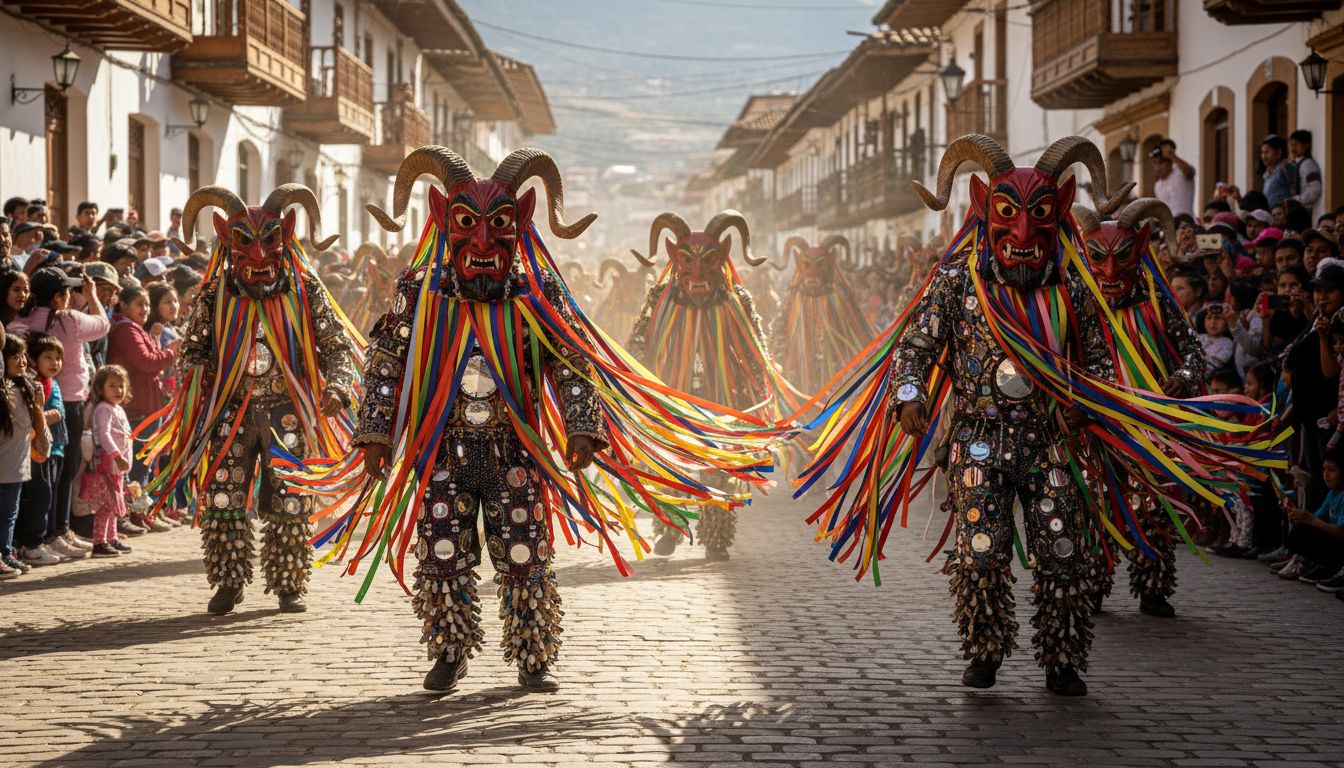
I arrived in Píllaro two days before New Year's Eve, when the small Tungurahua town was already thick with the smell of gunpowder and roasted corn. Firecrackers cracked somewhere behind the market stalls. A procession of masked figures moved through the square — horns catching the afternoon light, bells sewn into their costumes jangling with every stamping step. I had read almost nothing about this festival before arriving; I only knew, vaguely, that Píllaro's Diablada was supposed to be one of the more intense New Year devil-dance traditions in highland Ecuador. Within an hour of stepping off the bus, I understood why people made the trip.
What struck me first was the sheer density of devils. They seemed to be everywhere at once — in doorways, trailing children through the crowd, leaping onto the hoods of parked cars to the delight (or mock terror) of onlookers. Almost as soon as I began asking people where the tradition came from, I ran into something unexpected: nobody agreed. Ask one person and you'd hear about a vengeful hacienda owner. Ask another and the story shifted entirely, rooted in older Andean beliefs about the turning of the year. That contradiction, more than the masks themselves, is what kept pulling me back into conversation after conversation over the following days.
The Devils Themselves: Costumes, Horns, and Choreography
The masks are the first thing any visitor notices. Many appeared to incorporate real animal horns — cattle horns, by the look of them, though that's a detail a local mask-maker would need to confirm rather than something assumed from a distance. The horns were mounted onto carved wooden or papier-mâché faces, painted in deep reds and blacks, with exaggerated grins and sometimes mirrored eyes. Costumes varied noticeably from one group to the next: some dancers wore multiple layered ponchos that flared out dramatically with each spin, while others carried woven whips they cracked rhythmically against the ground.
Different neighborhoods, or at least different troupes, seemed to have their own stylistic signatures — a particular color palette, a specific way of tying the mask straps, a signature move in the group choreography. The dancing itself was demanding: long sequences of stamping, circling, and sudden lunges toward the crowd, sustained for what looked like hours at a stretch. Whether this reflects formal training passed down within families or more informal community rehearsal is something I couldn't determine on a short visit — a detail worth verifying directly with dancers or troupe organizers in future reporting.
Origin Story One: The Hacienda Legend
The first version of the devils' origin came from a man running a small shop near the main square, who told it the way one tells a story passed down rather than read in a book. In his telling, the tradition traces back to the colonial hacienda system that once dominated this part of Tungurahua — a cruel landowner, a punished worker, and a curse or transformation that left a mark on the community for generations afterward. He framed it as a kind of morality tale: a warning about the abuse of power dressed up, literally, as horns and fire.
This version leans heavily on themes of class tension and retribution. The devil, in this telling, isn't simply mischievous — he's a symbol of punishment turned back on those who once held power over others. It's the kind of story that would benefit from a conversation with a local historian or an elder with deeper genealogical ties to the hacienda era, since the shopkeeper acknowledged he'd heard it from his grandparents rather than from any written source.
Origin Story Two: The Indigenous/Syncretic Legend
A very different account came from a woman selling food near the edge of the procession route, who described the devils as something much older than colonial conflict — tied instead to Andean beliefs about the closing and opening of the agricultural year. In her version, the masked figures represent forces of transition, with Catholic New Year observance layered on top of a much older seasonal ritual. The horns, fire, and chaotic energy of the dance, in this telling, aren't about punishment at all, but about marking a threshold between one cycle and the next.
This account frames the festival less as a morality tale and more as a spiritual or cosmological event — a performance meant to usher out the old year's accumulated difficulties and welcome renewal. I found this version almost entirely through conversation rather than any written material; no pamphlet or sign in town mentioned it, which made it feel more fragile and more precious, dependent on asking the right question of the right person.
Why the Rivalry Over Origins Matters Locally
What became clear over several days in Píllaro is that these aren't simply two interchangeable folk explanations — people seemed genuinely invested in their version being the "real" one. A few residents hinted, half-joking, half-serious, at friendly rivalries between families or neighborhoods who favor one origin story over the other. Whether this reflects actual lineage claims — a family descended from the hacienda story's original participants, say — or simply generational and neighborhood pride is something that would require far more careful interviewing than I was able to do on this trip.
This kind of divergence isn't unique to Píllaro. Many Latin American festivals carry multiple, sometimes competing oral histories, often splitting along lines of generation, class, or indigenous versus colonial-era framing. As told to me, these origin stories felt less like historical claims to be fact-checked and more like living arguments about identity — about which version of the town's past the tellers want to keep alive.
A Night Among the Diablos: Personal Encounter
On New Year's Eve itself, a dancer pulled me aside near the edge of the square and, laughing, offered to let me try on his mask. It was heavier than I expected, the horns throwing off my sense of balance as I turned my head. Through the mask's narrow eye slits, the crowd blurred into color and firelight. He told me, half-shouting over the noise, that his grandfather had danced the same role — though which origin story he believed, hacienda or cosmological, he waved off the question, saying only that "it doesn't matter which story is true, we dance either way."
That line stuck with me. Standing there, still wearing a borrowed devil mask, surrounded by competing versions of a single legend, I felt the particular disorientation of being an outsider trying to pin down a "correct" account that the town itself didn't seem to need. The music swelled, fireworks lit up the horned silhouettes moving through smoke, and for a moment the argument over origins felt beside the point entirely.
Leaving Píllaro: Unresolved Devils, Lasting Impression
I left Píllaro without ever settling which origin story was "true," and I've come to think that was never really the assignment. The value of the trip wasn't in adjudicating between the hacienda legend and the Andean cosmological account — it was in watching a community hold both stories at once, each one doing different emotional and cultural work for the people who tell it.
As an expat still learning how memory and storytelling function differently here than at home, Píllaro's Diablada offered something larger than a festival to observe: a small lesson in how history can remain genuinely unresolved, generation after generation, without losing any of its power. One of the dancers, pulling off his mask at the end of the night, sweat-soaked and grinning, put it simply: "Ask ten people in this town, you'll get ten versions of the devils. All of them are true, because we're still telling them." Editors should note that all quotes, dates, and legend details in this piece are drawn from brief, unverified conversations and require follow-up reporting or local-source confirmation before publication.