Colada Morada, Bread Babies and Graveside Picnics: Why Ecuador's Día de Difuntos Startles Halloween-Raised Expats
Colada Morada, Bread Babies and Graveside Picnics: Why Ecuador's Día de Difuntos Startles Halloween-Raised Expats
I grew up in Ohio, where the first days of November meant leftover candy wrappers, deflating inflatable ghosts on neighbors' lawns, and the faint sense that the scary season had officially ended. So when someone in Cuenca mentioned, almost reverently, that November 2nd was a big day, I assumed more of the same: maybe a quieter, Latin American remix of Halloween. I pictured plastic skeletons and perhaps a parade.
What I found instead had nothing to do with fright at all. Día de Difuntos, Ecuador's observance of the Day of the Dead and All Souls' Day, turned out to be solemn, tender, and deeply food-centered in a way that no amount of American trick-or-treating had prepared me for. Where Halloween trades in commercial scares, costumes, and candy, Difuntos is about remembrance, family, and an entirely different relationship with the dead. It was, in short, the night I realized I wasn't in Ohio anymore.
Purple Drinks and Bread That Looks Like Babies
The first clue that something unusual was happening came in the form of a drink the color of a bruise. Colada morada is a thick, spiced beverage made from Andean blackberries and other fruits, colored and thickened with purple corn flour until it has the consistency of a loose pudding more than anything you'd call a beverage back home. It's warm, fragrant with cinnamon and clove, and faintly sweet in a way that felt both comforting and completely foreign on my tongue.
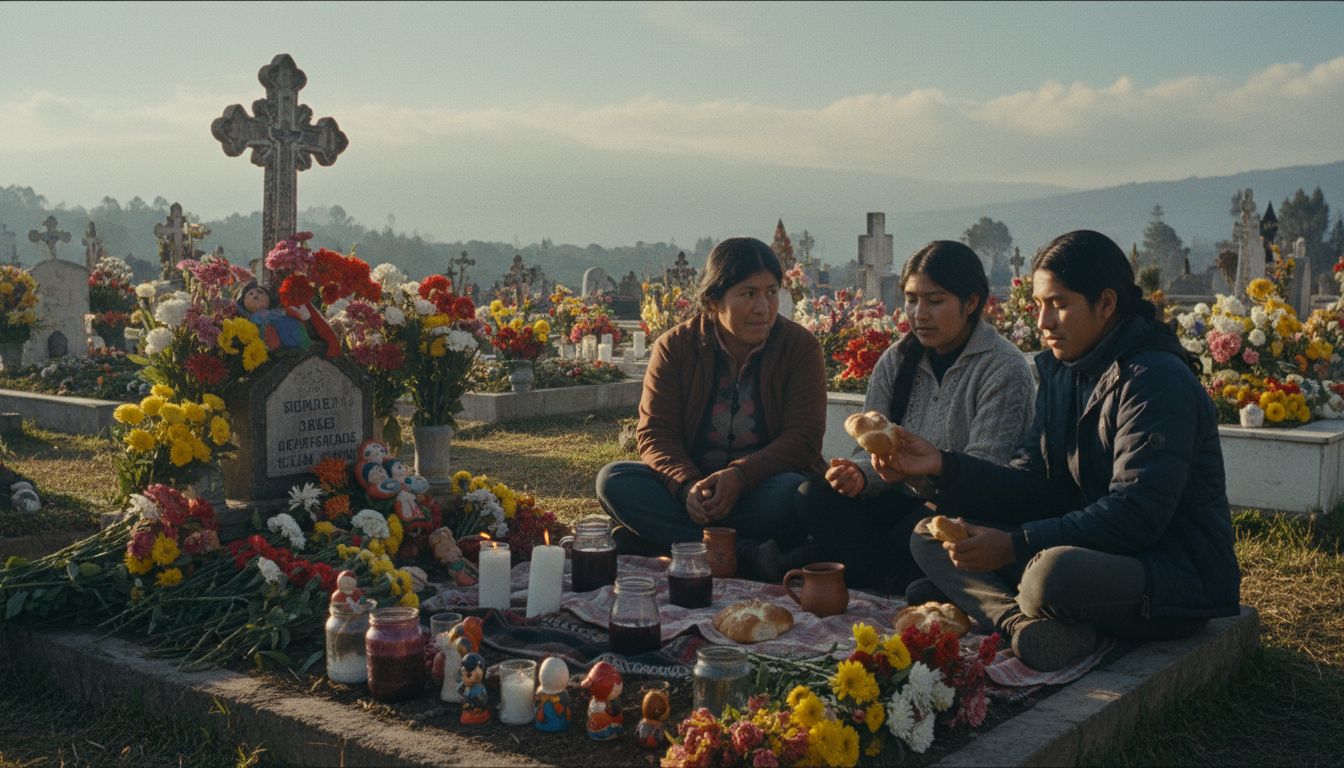
Then came the bread. Guaguas de pan, or "bread babies," are sweet rolls shaped unmistakably like swaddled infants, often with simple faces pressed into the dough. They're the traditional companion to colada morada, and the first time someone handed me one and gestured for me to eat, I hesitated. There is something genuinely strange, from an outsider's perspective, about a holiday built around sipping something thick as a smoothie while eating bread shaped like babies. It took a few bites before I stopped seeing the novelty and started tasting the comfort: this wasn't shock value, it was tradition, familiar and unremarkable to everyone around me.
Picnics Among the Headstones
If the food caught me off guard, the cemeteries undid me completely. Where I come from, graveyards are places you walk through quickly, speak in hushed tones, or avoid altogether after dark. They are, culturally, the backdrop for ghost stories, not family outings.
In Ecuador, families spend the day at the cemetery cleaning headstones, bringing flowers, and settling in with food as though at a picnic. There's an unhurried, communal quality to it: people chat, eat, and spend real time at the gravesides of relatives, sometimes for hours. My inherited instinct, the one that treats cemeteries as quiet or even frightening spaces, had no framework for this at all. But watching families linger there, it became clear this wasn't mourning in the way I understood it. It was connection. It was simply spending the day with people who happened to no longer be living.
Why the Dead Aren't Scary Here
Some of this, I came to understand, traces back to a blending of indigenous Andean traditions of honoring ancestors with the Catholic observance of All Souls' and All Saints' Days. Without pretending to know the precise historical details of how these traditions merged over time, the general cultural pattern is widely recognized: two belief systems, each with its own way of acknowledging those who have died, layered into a single observance.
What struck me most was not the specific history but the resulting worldview. Death, in this context, isn't treated as something to banish behind a costume or laugh off with candy. It's treated as a continuation, a relationship that doesn't end so much as change shape. The dead remain, in some sense, part of the family gathering. That idea alone reframed everything else I'd seen that day.
What Halloween Never Taught Me
Halloween, for all its charm, never asked me to think seriously about death. It offered fear as entertainment, a controlled scare followed by candy and relief. Día de Difuntos asks something entirely different: to sit with loss, to feed it, to bring it to the table rather than push it into the shadows.
I don't think I fully processed grief, my own or anyone else's, until I watched an Ecuadorian family laughing softly over a cup of colada morada beside a grave they'd just decorated. It wasn't sad in the way I expected sadness to look. It was warm. It made me reconsider how my own culture handles memory and mortality, often by avoiding the subject entirely until we're forced to confront it.
This, I think, is the quiet gift of being an expat: not just learning new foods or new holidays, but occasionally having your assumptions about something as fundamental as death gently, memorably rearranged. I came to Ecuador expecting a stranger version of Halloween. I left with a new, and much gentler, way of thinking about the people I've lost.