Bella Aurora and the Black Bull: The Haunting Behind Quito's Most Feared Address
Bella Aurora and the Black Bull: The Haunting Behind Quito's Most Feared Address
The first time I walked past García Moreno 1028, I didn't know its name yet. I only knew that the woman selling candy from a cart on the corner watched me approach the building, then looked away, quickening her own pace as if my presence near it might invite something to notice her too. It was late afternoon, the light doing that particular Quito thing where the colonial facades turn gold and the shadows in the doorways turn the opposite. I asked her, half in jest, if the building was for sale. She didn't laugh.
What follows is not a history. It is, as far as I can tell after months of asking questions in a city that answers slowly, a legend — one told and retold with enough consistency that it has become part of how a neighborhood understands itself, and enough variation that no two versions agree on the details. This is a piece about that legend, about the address that carries it, and about what it feels like as an outsider to live beside a story that refuses to be either confirmed or forgotten. At its center are two recurring figures: a woman called Bella Aurora, and an apparition known simply as the Black Bull.
The Address Itself: Why 1028 Stands Apart
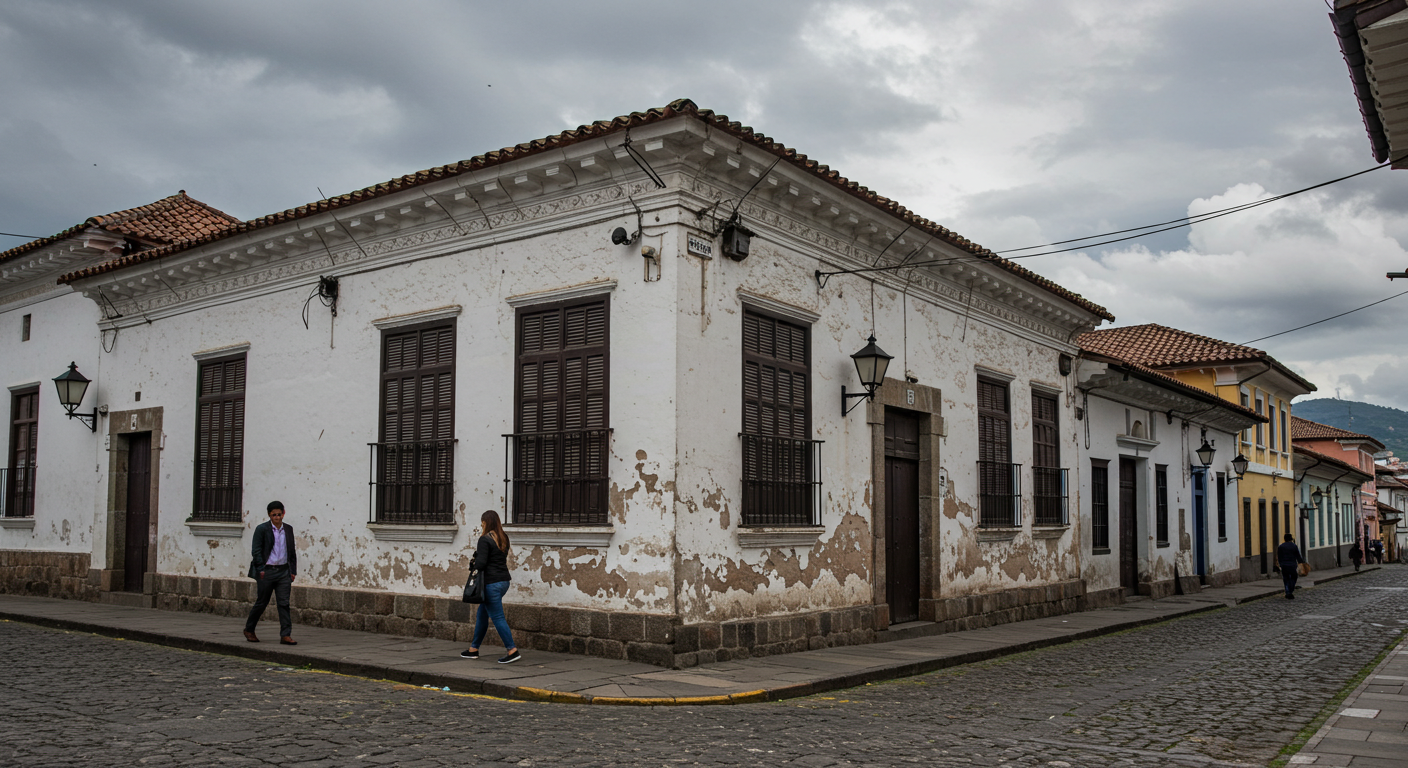
García Moreno 1028 does not announce itself. It is, by daylight, an unremarkable colonial-era facade among many in Quito's historic center — thick walls, a heavy door, windows set deep into stone. What sets it apart is not architecture but reputation. Mention the address to a taxi driver, a shopkeeper, or an older resident of the surrounding blocks, and the reaction is rarely neutral. Some cross themselves. Others simply change the subject, or answer with a story that contradicts the one you heard an hour before.
I want to be clear about what I can and cannot verify here. I haven't seen a property deed, a historical registry entry, or any documented account of who owned the building or when. What I have is what residents tell me, and what they tell me is consistent enough in tone, if not in fact, to suggest that the address has taken on a life of its own within the neighborhood's collective memory. Whatever the building's actual architectural or ownership history may be, its reputation has become, for practical purposes, part of the local identity — a landmark defined less by brick and more by the stories attached to it.
The Legend of Bella Aurora
Ask three people about Bella Aurora and you may get three different women. In one telling, she was a beauty of the colonial era, kept behind those thick walls by a jealous husband or father, her fate tied to betrayal and an early, unjust death. In another version, she is more tragic than victimized — a woman who chose the house and the isolation, and whose grief simply never left the property. A shopkeeper near the address once told me she was murdered; a neighbor two doors down insisted, just as firmly, that she disappeared and was never found, which is why her spirit is said to still be searching.
What stays constant across these retellings is not plot but emotional register: beauty, tragedy, and betrayal recur as the load-bearing motifs of the story, regardless of which specific details are attached to them in a given telling. This consistency of feeling, even amid inconsistency of fact, is itself worth noting — it suggests Bella Aurora functions less as a historical figure and more as a vessel for a particular kind of communal storytelling, one that Quito's historic center seems to return to again and again. None of what follows should be read as biography. It is folklore, passed mouth to mouth, shaped by whoever is doing the telling.
The Black Bull: A Recurring Apparition
The second figure in the legend is stranger, and in some ways more unsettling precisely because it resists easy explanation. Residents speak of a black bull — not metaphorical, but described as an actual apparition, seen or sensed near the address, often at night. In Andean and broader Ecuadorian folklore, animal apparitions and spectral guardians are not unusual; the black bull in particular carries associations with the demonic and the threshold between worlds in various regional traditions, though I want to be cautious about overstating a direct lineage without documentation to support it.
What I can share is how the encounters are described to me: a sense of being watched near the doorway, a shape glimpsed at the edge of vision that resolves, however briefly, into something with horns and weight and breath. Some tellings connect the bull directly to Bella Aurora — as her guardian, her tormentor, or the manifestation of whatever violence attached itself to her story. Others treat the bull as a separate haunting entirely, one that simply shares the address by coincidence, or by some logic of accumulated dread that the neighborhood has never quite worked out. I offer these as reported elements of a shared local narrative, not as claims about what actually occurs at 1028.
An Expat's Perspective: Encountering the Unknown
I grew up with a different vocabulary of hauntings — a specific set of ghost stories from home, tied to different landscapes and different fears. There is a particular vertigo in encountering a legend that is not yours, embedded in a culture you are still learning, told by people who have every reason to know the story better than you ever will. My instinct as an outsider is often skepticism first. But skepticism, applied carelessly, can shade into dismissiveness, and dismissiveness feels like the wrong response to something that clearly matters to the people telling it.
So I've tried to hold two things at once: an honest uncertainty about whether anything supernatural occurs at García Moreno 1028, and a genuine respect for what the story does within the community that keeps it alive. A taxi driver once refused, half-joking and half not, to idle near the address for more than a minute. A shopkeeper insisted, without hesitation, that the story was simply true — not legend, not metaphor, just fact, the way the weather is fact. I don't know how to reconcile that certainty with my own doubt. I'm not sure I'm supposed to.
Why the Legend Endures
There is no documented source I've been able to find for Bella Aurora or the Black Bull — no newspaper archive, no municipal record, no academic study that I could locate. That absence is worth sitting with rather than explaining away. It means the story, whatever its origins, survives entirely through oral tradition: told by residents to newcomers, by parents to children, by shopkeepers to curious foreigners like me who ask too many questions on a slow afternoon.
Legends like this one tend to persist for reasons that have little to do with their factual accuracy. They reinforce a neighborhood's sense of itself — its caution, its shared history, its boundaries between the ordinary and the uncanny. Quito's historic center, with its centuries of layered colonial architecture and its narrow, shadowed streets, seems particularly suited to this kind of storytelling; the physical geography almost invites it. Without documented sources, the responsible way to read this story is as exactly what it presents itself as: folklore, communal memory, a piece of the city's hidden geography that exists because people keep choosing to tell it, not because it can be proven.
Closing: Living Beside the Legend
I still walk past García Moreno 1028 more often than I probably need to. I don't quicken my pace the way the candy vendor did on that first afternoon, but I notice the building now in a way I didn't before I knew its reputation. That noticing is, I think, the real inheritance of a legend like this — not proof of anything, but a permanent shift in how a place is perceived by everyone who hears the story.
I don't know what happened at that address, if anything happened at all. I don't know if Bella Aurora existed, or if the Black Bull is anything more than a shape half-conjured by shadow and suggestion. What I know is that the story persists, that it matters to the people who tell it, and that it has become, for better or worse, part of what it means to walk that particular street in Quito. This was never meant to be a piece about what is true. It's a piece about what refuses to be forgotten — and about what it feels like, as an outsider, to live beside it.