A Wildfire on Quito's Cerro Casitagua Burned Away the Brush and Exposed a Stone Stairway, Possibly Inca
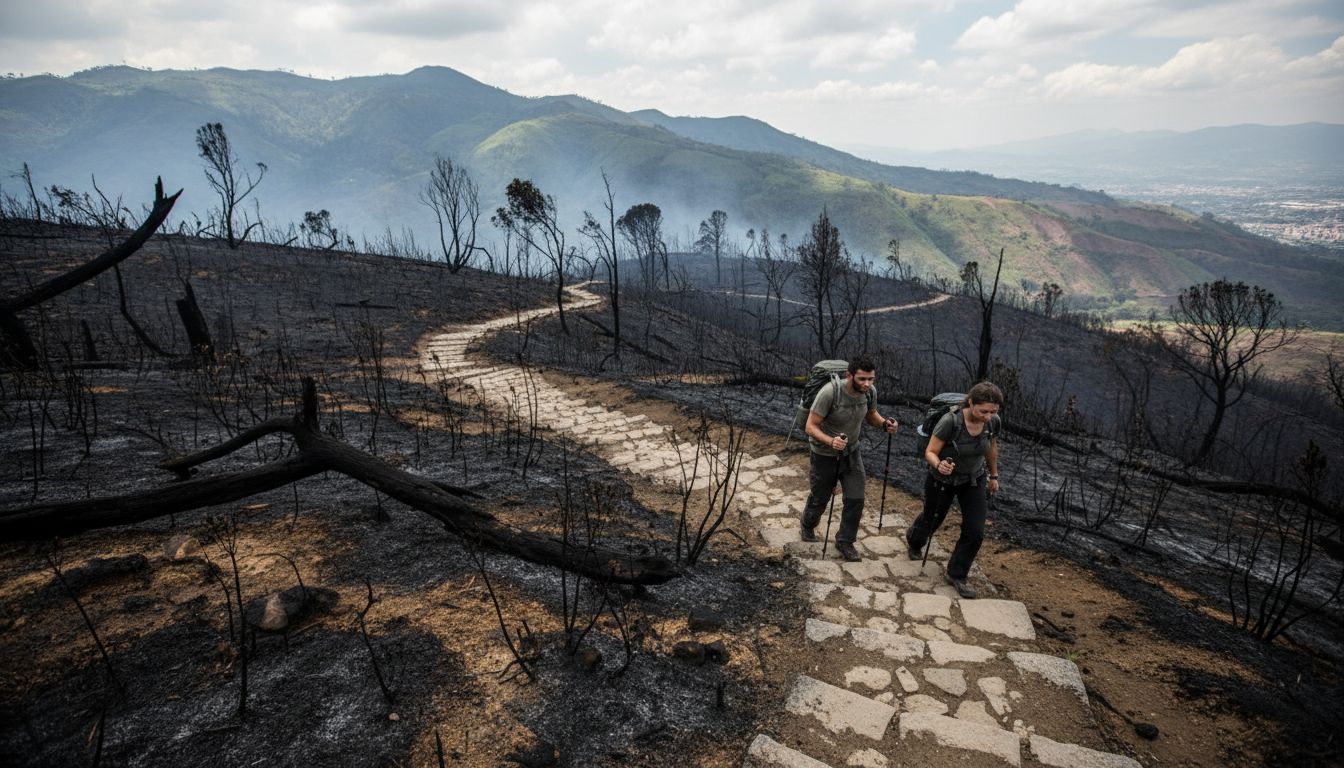
Living on the outskirts of Quito, I've grown used to the sight of Cerro Casitagua on the horizon, a quiet volcanic presence that frames the northern edge of the valley. So when smoke began rising from its slopes one dry-season afternoon, it was hard to look away. What started as a thin gray line against the sky thickened over the course of a day into a heavy plume visible from across the city.
Neighbors gathered on rooftops and sidewalks, phones out, tracking the fire's progress the way people do when something feels both alarming and strangely captivating. Ash drifted down over parts of the city, settling on car windshields and windowsills. WhatsApp groups filled with photos and half-confirmed updates. I want to be clear that what follows is a personal account, not an official incident report. I don't have access to firefighting logs or municipal statements, only what I saw, heard, and pieced together from conversations with neighbors in the days that followed.
When the Smoke Cleared
By the time the fire had run its course, the change in the hillside was stark. Slopes that had been covered in dry scrub and grass were reduced to blackened earth, the vegetation stripped away almost entirely. It's a common enough sight after a wildfire in this region, and most people expected the story to end there, with the slow work of regrowth beginning in the following rainy season.
Instead, something else emerged. Within days, word spread that a stone stairway had become visible on the cleared slope, its outline no longer hidden beneath brush and undergrowth. Photos began circulating locally, showing a series of stacked stone steps climbing part of the hillside. For many residents, Ecuadorian and expat alike, the discovery was almost more startling than the fire itself. A landscape everyone thought they knew had revealed something none of them had noticed before.
Whispers of the Inca
It didn't take long for speculation to take hold. Given the region's deep pre-Columbian history, many in the community began wondering aloud whether the stairway might be Inca in origin, or perhaps tied to an earlier Indigenous culture that predated Inca expansion into the northern Andes. I want to be careful here: this is community rumor and local speculation, not a confirmed archaeological finding. As of this writing, I'm not aware of any official statement from heritage authorities or archaeologists verifying the age, origin, or construction of the stairway.
Still, it's easy to understand why the theory took hold so quickly. Ecuador's highlands are layered with history in a very literal sense. Indigenous settlements, Inca administrative and ceremonial sites, and colonial-era construction often sit close together, sometimes built directly atop one another. Cerro Casitagua itself is known among hikers and locals for scattered signs of past human presence. Against that backdrop, a stone stairway suddenly exposed by fire feels like exactly the kind of thing that could plausibly connect to a much older past, even if that connection hasn't been established.
Living Near Layers of History
There's something particular about living in a place where history doesn't stay neatly buried. In other parts of the world, the past feels distant, something read about rather than encountered. Here, it can resurface almost overnight, in this case, quite literally, after a fire clears away decades of undergrowth.
As an expat, I've found myself sitting with a mix of curiosity and caution about this whole episode. Part of me wants the stairway to be something extraordinary, a tangible link to the Inca presence in this region. But I'm also aware that jumping to conclusions, or repeating unverified claims as fact, does a disservice to the actual history and to the people and institutions whose job it is to study it properly. Speculating from the sidelines feels different from asserting a conclusion, and I've tried to stay on the right side of that line.
Waiting for Answers
For now, plenty of questions remain open. Will archaeologists or heritage officials examine the site? Could the stairway turn out to be far more recent, perhaps an agricultural terrace, an old property boundary, or another structure with a more mundane explanation? Or might it genuinely connect to the pre-Columbian past that so many hoped it would?
As of this writing, there's no archaeological or governmental confirmation either way. What's clear is that discoveries like this, sudden, unexplained, and wrapped in local speculation, have a way of capturing the imagination of everyone living nearby. For expats especially, moments like this are a reminder of just how much unseen history surrounds daily life in Ecuador, and how much remains to be understood, verified, or simply left as an open question for now.