A Small Act of Kindness I’ll Never Forget
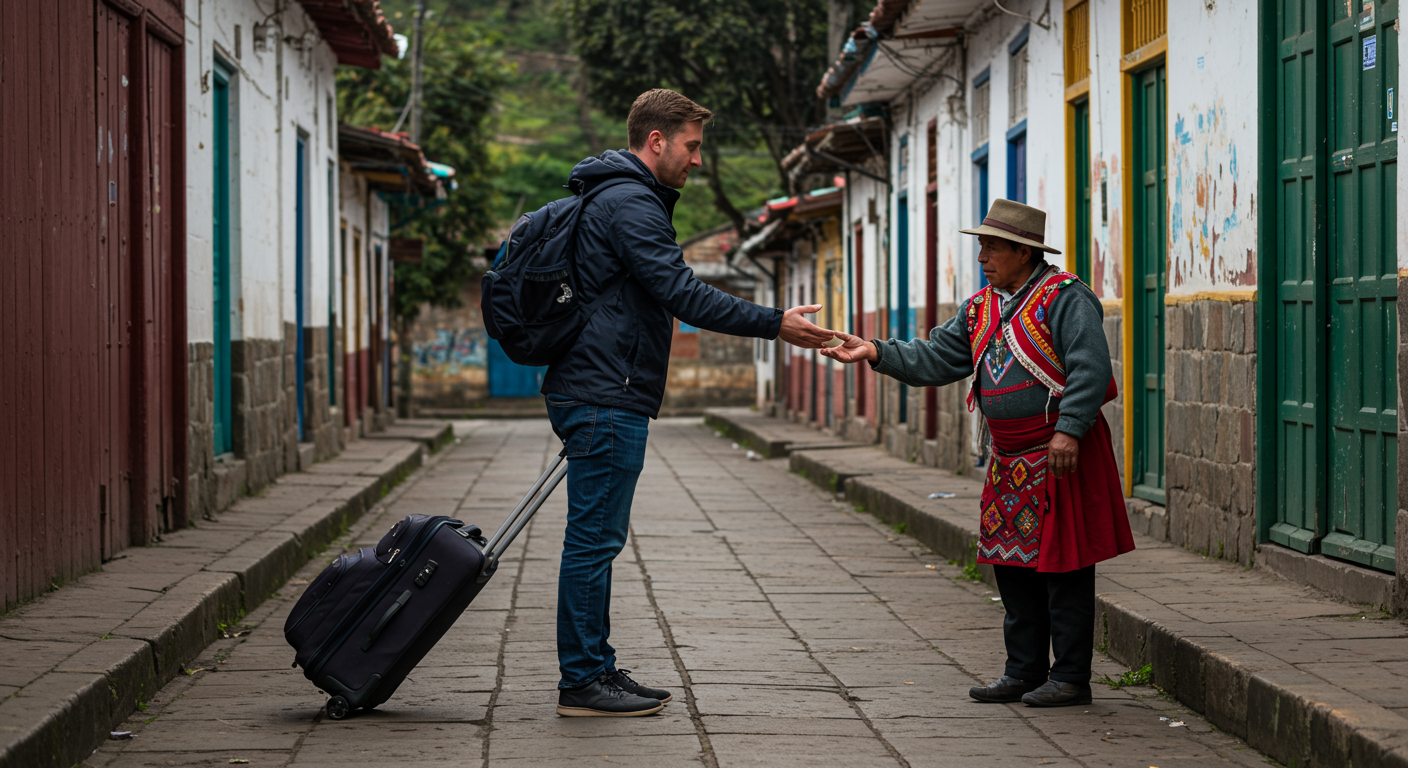
It was late afternoon in Cuenca, during one of those gray, drizzly stretches when the whole city seems to fold in on itself. The sidewalks were slick, the air had that cold high-altitude bite, and I was standing at a bus stop near the edge of downtown trying not to cry in public.
I had been out all day handling paperwork that should have taken an hour and had somehow swallowed the entire afternoon. By then I was tired, hungry, and carrying a folder full of documents whose corners had gone soft from the mist. My phone battery was nearly dead. I was not entirely sure I was even at the right stop, and every bus that passed had a sign I could not read quickly enough before it rattled away.
None of this was a disaster in any grand sense. I was not in danger. But in that moment it felt like everything had piled up at once: the language I still spoke too slowly, the constant low-grade uncertainty of living in a place that was not yet mine, the exhaustion of having to think through ordinary tasks that used to be automatic. What was at stake was not just getting home. It was the fragile confidence I had been trying to build since moving abroad.
The Moment Everything Felt Too Much
I remember clutching my folder against my chest and watching people move around me with the ease I envied. They knew where to stand, when to wave, which bus to board, how to ask quick questions without rehearsing them first in their heads. I felt conspicuous in the way foreigners often do when they are already having a hard day: too hesitant, too careful, too easy to spot.
By then, small embarrassments had started to feel larger than they were. Earlier that day I had misunderstood directions in an office and waited in the wrong line for nearly forty minutes. Then I had filled out one form incorrectly and had to start again. No one had been cruel. That almost made it worse. The world was simply moving at its normal speed, and I was the one struggling to keep up.
Standing there at the bus stop, I felt a kind of loneliness that had very little to do with being physically alone. It was the loneliness of not having anyone nearby who knew my baseline. No friend to text, no familiar voice to call without calculating time zones, no parent or sibling who could say, “Take a breath. Here’s what to do next.” Living abroad had made me more capable in many ways, but it had also exposed how thin-skinned and unsteady I could feel on certain days.
Why I Felt So Alone in That Moment
I think what magnified everything was how new I still was to daily life there. When you first move to another country, people often talk about the exciting parts: new streets, new food, the thrill of reinvention. They talk less about the mental wear and tear of ordinary errands. How every interaction demands just a little more focus. How one bureaucratic snag, one wrong turn, one missed phrase can drain you more than it should.
That afternoon, I was carrying more than papers. I was carrying the private fear that maybe I was not adjusting as well as I told people back home I was. I was embarrassed by how close I was to tears over something as simple as figuring out a bus. I was homesick in the sneakiest way, not longing for one specific person or place but for the feeling of competence I used to have without even noticing it.
And because I was abroad, everything seemed to carry extra emotional weight. If I got lost at home, it was an inconvenience. If I got lost here, it felt like evidence. Evidence that I was still an outsider. Evidence that I could live in a beautiful city and still, in one small stranded moment, feel very far from belonging.
The Small Act I’ll Never Forget
A woman standing a few feet away had noticed me before I noticed her. She looked to be in her sixties, bundled in a dark sweater with a plastic shopping bag looped over one wrist. She caught my eye, tilted her head gently, and asked something I did not fully understand the first time.
I managed to say, in halting Spanish, that I was trying to get home and did not know which bus to take. I remember feeling my face go hot with embarrassment as I spoke. I expected the usual kind smile people give when they understand only half of what you mean.
Instead, she stepped closer to the curb with me and asked for the neighborhood name. I told her. She repeated it back carefully, as if making sure she had heard me right. Then she nodded and said, slowly enough for me to follow, that she would tell me which one.
For the next several minutes, she simply waited with me.
Each time a bus approached, she leaned forward to read the sign before I could. Twice she shook her head. Not that one. Then another came, brakes sighing against the wet street, and she lifted her hand and pointed with certainty. This one.
I fumbled in my bag for coins, and before I could sort them, she reached out and pressed my hand closed over the wrong change with a little smile, then opened her own purse and handed me the correct amount. It was almost nothing, just a few coins, but she did it so quickly and naturally that there was no room for protest. When I tried to object, she waved it away.
Then, because she seemed to understand that my worry was bigger than bus fare, she did one more thing. She spoke to the driver for me. Not dramatically, not with any fuss. Just a brief exchange through the open door, one local person making sure another person would get where they needed to go. She turned back to me and motioned that it was fine, that I should get on.
I still remember the warmth of the bus as I climbed aboard from the cold street. I remember turning back and seeing her give a small nod, almost businesslike, as if this were the most ordinary thing in the world. Then the doors folded shut and she disappeared into the drizzle.
What Made It Mean So Much
What stays with me is not only that she helped. It is how little she made of it. She did not perform kindness. She did not treat me like a spectacle, or like a burden, or like a confused foreigner in need of some grand rescue. She simply noticed that I was overwhelmed and quietly stepped into the gap.
At that moment, what I needed most was not expertise or efficiency. I needed to feel less alone in my own incompetence. Her kindness gave me something larger than directions. It gave me back a little dignity. It interrupted the story I had been telling myself—that I was stranded, that I was failing, that I was painfully visible in the worst way.
There was also something deeply comforting about the practical nature of what she did. She did not offer abstract reassurance. She stayed. She checked the buses. She covered the coins. She spoke to the driver. It was kindness translated into action, and because of that, it reached me more deeply than comforting words might have.
I do not take that moment as proof of anything sweeping about a country or a culture. It was one person, one rainy afternoon, one simple gesture. But personally, it mattered because it arrived at exactly the point where my confidence had worn thin. Her help made the city feel, for the first time that day, not like a maze I had to conquer but like a place where I might someday find my footing.
What I Carried With Me Afterward
By the time I stepped off the bus near home, the practical problem had been solved, but the emotional shift lingered. I was still tired. The paperwork was still annoying. The weather was still cold. Yet everything felt lighter. I was no longer carrying the day alone.
That brief encounter changed something subtle in how I moved through life afterward. I think I became less afraid of needing help and more aware of how powerful ordinary generosity can be when someone is far from home. It also made me pay closer attention to people who look lost, hesitant, or one bad moment away from tears. Especially newcomers. Especially people trying hard not to inconvenience anyone.
I still do not know that woman’s name. I never saw her again. She may not remember me at all. But I remember her every time I stop to give directions, every time I slow down for someone searching for the right word, every time I choose patience over efficiency.
When you live abroad, people often assume the unforgettable moments will be the big ones: the views, the milestones, the dramatic adventures. But sometimes what lasts is something much quieter. A stranger in the rain. A few coins. A word to the driver. A reminder, when you need it most, that being far from home does not always mean being alone.