A Mystery Petroglyph in Quilanga and the Return of Loja's Inca Road
A Mystery Petroglyph in Quilanga and the Return of Loja's Inca Road
A Small Plaza, A Surprising Discovery
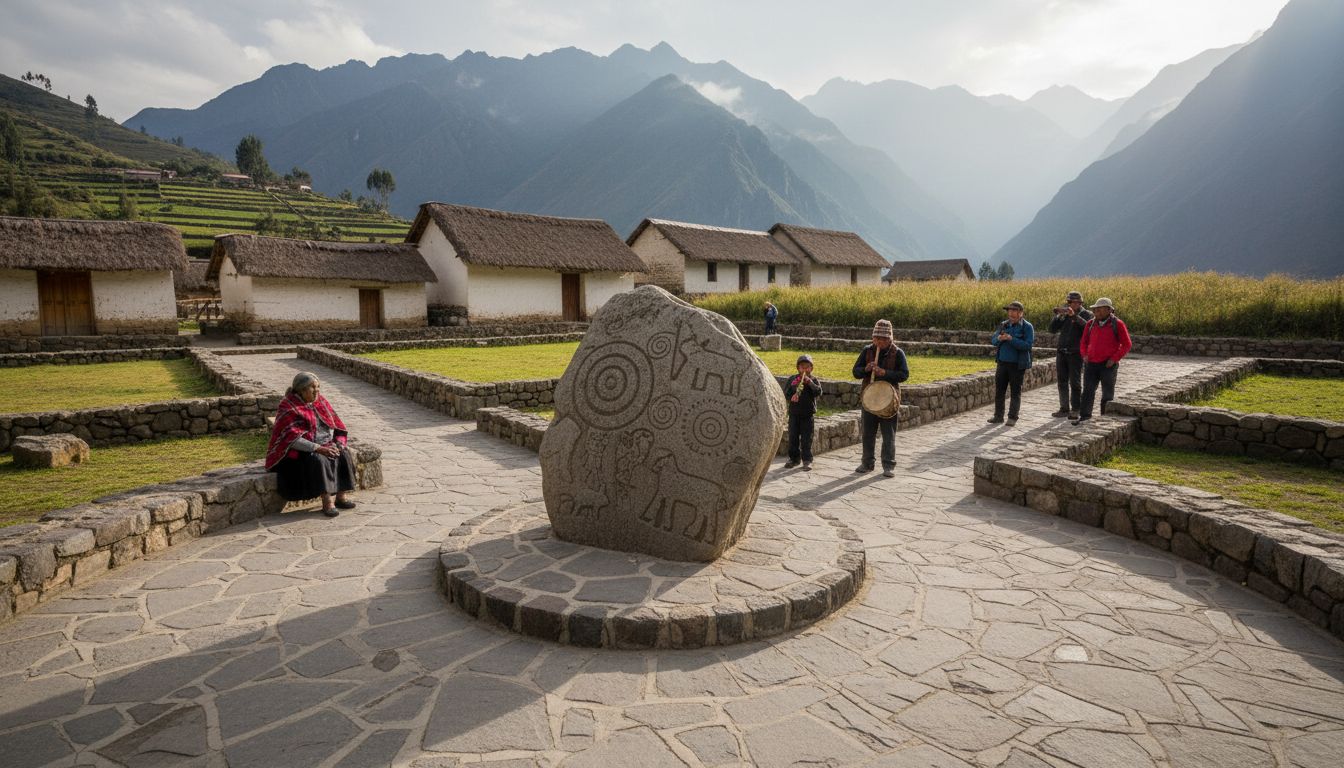
Quilanga is the kind of place many expats in southern Ecuador come to love precisely because nothing much seems to happen there. Tucked into the hills of Loja province, the town moves at an unhurried pace, its daily rhythms shaped more by weather and harvest than by headlines. So when word began circulating that a carved stone—an apparent petroglyph—had surfaced at the town's Plaza del Inca, it was enough to send a ripple of curiosity through the community.
Many local observers note that the carving appeared in an entirely ordinary setting, which is part of what makes the story so compelling. A public plaza, not a remote excavation site, became the unlikely stage for what may be a genuinely old piece of rock art. At this stage, though, much remains unknown. Who found it, when exactly it surfaced, what imagery it bears, and how old it might be are all details that have not been independently confirmed. What can be said is that the discovery has become a talking point—speculation, questions, and a fair amount of local pride have followed in its wake.
What We Know (and Don't) About the Carving
Petroglyphs—images carved or pecked into rock surfaces—are found throughout the Andes, left behind by generations of cultures stretching back centuries, sometimes millennia. They often depict human figures, animals, geometric patterns, or symbols whose meanings are debated even among specialists. It's tempting to assume that any carving found in a historically rich region like Loja must connect directly to the Inca past, but that kind of attribution requires careful archaeological study.
In the case of the Quilanga carving, no confirmed information is yet available to establish its age or cultural origin. A recurring concern in situations like this is that enthusiasm outpaces evidence—understandable, given how exciting a discovery can feel, but worth resisting. Typically, experts investigating a find like this would examine the carving technique, surrounding soil or stratigraphy if available, comparative imagery from known regional sites, and any oral history from residents who might recall the stone's presence over time. Until that kind of analysis happens, the honest answer is that the carving's story is still being written. There's something fitting in that: the mystery itself, for now, is part of the appeal.
The Qhapaq Ñan: Loja's Living Connection to the Inca Road
Running parallel to the petroglyph story is news of a different kind of recovery: roughly five kilometers of the Qhapaq Ñan reportedly being reclaimed within Loja province. The Qhapaq Ñan, or Great Inca Road, was a vast network of pathways that once connected communities across the Andes, linking what are now Ecuador, Peru, Bolivia, Chile, Argentina, and Colombia. UNESCO recognized the network as a World Heritage site, acknowledging both its engineering achievement and its role as a living cultural corridor.
The idea of recovering even a short stretch of this road within Loja speaks to a broader regional effort to reconnect with that heritage—physically and symbolically. Exact details about which agencies or officials are leading this particular recovery, or the precise timeline involved, remain unconfirmed and should be treated as general rather than specific claims. What does seem clear is that this kind of work fits a larger pattern across southern Ecuador, where cultural and historical sites are increasingly viewed as assets worth preserving, both for their intrinsic value and for the tourism interest they generate.
Why This Matters for Expats in Southern Ecuador
For expats who've chosen to settle in Loja province, stories like these tend to resonate beyond simple curiosity. Many who relocate to small Andean towns cite a desire to live somewhere with depth—places where daily life unfolds against a backdrop of long, layered history. A petroglyph appearing in a town plaza, or an ancient road reemerging after presumably long disuse, reinforces that sense of proximity to something larger than the everyday.
There's also a practical dimension. Discoveries like this often feed into local pride and, over time, can shape how a town presents itself to visitors. Small communities in Loja have increasingly leaned into cultural tourism as a complement to agriculture and quieter rural economies. A recurring theme among expats in the region is the appeal of watching that identity take shape—not as a finished museum piece, but as something still being negotiated and discovered.
A Story Still Unfolding
It's worth repeating: much about both the Quilanga petroglyph and the Qhapaq Ñan recovery remains unconfirmed. Readers should treat specific details—origins, dating, scope of the roadwork—as preliminary rather than settled fact. What seems certain is that both threads represent stories worth continuing to watch, as more information likely emerges in the coming months.
For those living an expat life in places like Loja, this is perhaps a familiar feeling: settling into a landscape where history isn't just something read about, but something that occasionally surfaces, quite literally, underfoot. There's a particular kind of privilege in that—not certainty, but the ongoing invitation to stay curious.