A Lost Booby, a Restless Ocean: Watching for El Niño's Shadow in the Galápagos
A Lost Booby, a Restless Ocean: Watching for El Niño's Shadow in the Galápagos
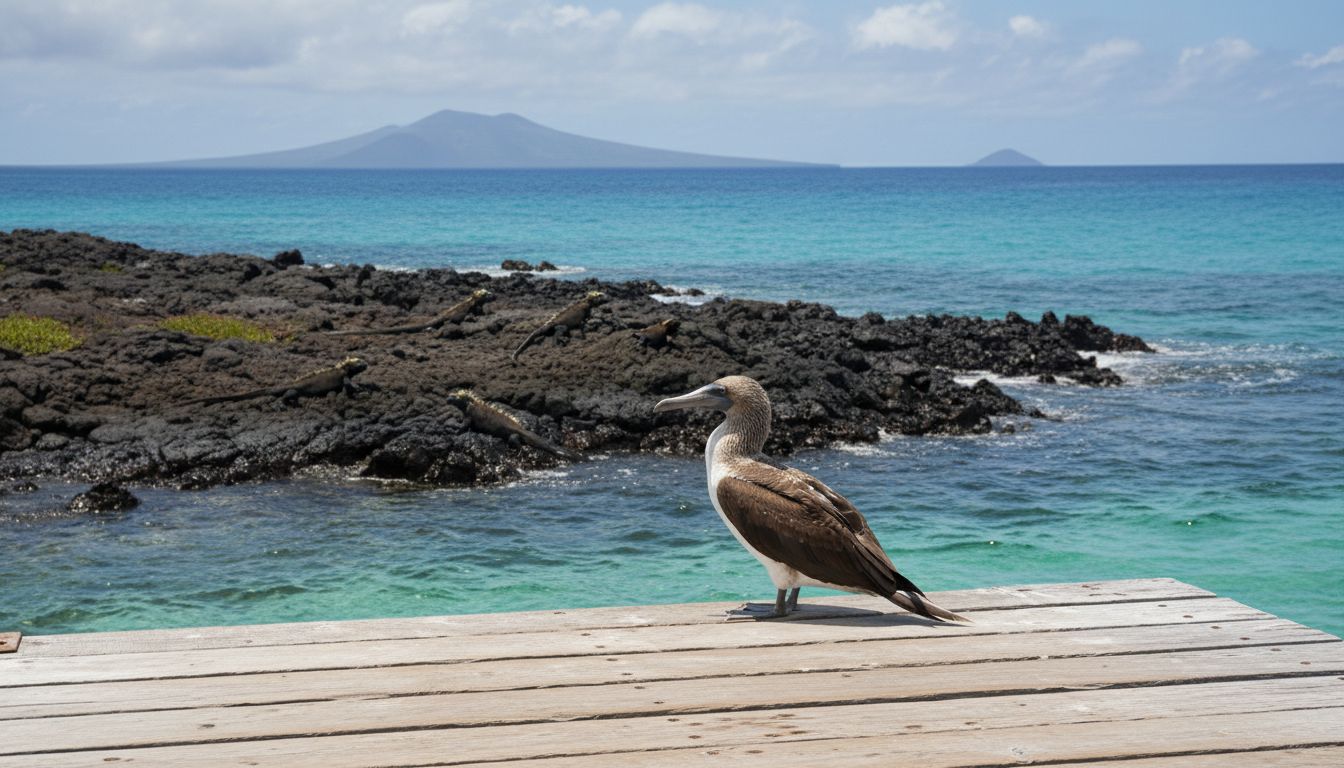
It was an ordinary morning by the water when something unusual caught my eye: a Brown Booby, clearly disoriented, had landed on the dock near my home. Anyone who has spent time in the Galápagos knows these seabirds are strong, confident fliers, built for diving and distance. Seeing one sitting awkwardly on the planks, seemingly unsure of itself, was enough to stop me mid-step.
A Strange Visitor on the Dock
Living as an expat near the Galápagos coastline means developing a quiet attentiveness to the rhythms of the water and the creatures that depend on it. Sea lions nap on benches, marine iguanas sun themselves on volcanic rock, and boobies dive-bomb schools of fish just offshore. It is a landscape where the ordinary is already extraordinary, which is exactly why an out-of-place bird registers so strongly.
I want to be clear that this is a personal observation, not a scientific survey. One booby on one dock on one morning tells us very little on its own. But it was enough to send me down a rabbit hole of questions about what might be happening beneath the surface of these waters—questions that lead directly to El Niño.
What El Niño Means for the Islands
El Niño refers to a periodic warming of sea surface temperatures in the central and eastern Pacific Ocean. It is a naturally recurring climate pattern, not a new phenomenon, though its intensity and timing vary considerably from one event to the next.
Early meteorological outlooks have raised the possibility of an El Niño event forming in 2026, though such forecasts remain uncertain and are subject to change as the season develops. Climate scientists typically caution against treating early-season outlooks as fixed predictions, and that caution applies here as well.
In general terms, the mechanism that concerns Galápagos observers is this: warmer surface waters tend to suppress the cold-water upwelling that normally rises from the deep ocean around the islands. That upwelling is the engine of the Galápagos food web, carrying nutrients that support plankton, fish, and in turn the many species that feed on them.
Galápagos Penguins: Life on the Edge of a Changing Current
The Galápagos penguin, one of the rarest penguin species in the world, depends heavily on cold, nutrient-rich water to sustain the small fish it hunts. When upwelling weakens, the fish populations these penguins rely on can become harder to find.
Researchers who have studied the species over past decades note that strong El Niño events have historically been associated with periods of stress for penguin populations in the archipelago. It's worth emphasizing that outcomes have varied across different El Niño events, and attributing any single season's impact requires careful, after-the-fact study rather than in-the-moment assumption.
What might this look like on the ground, if conditions were to shift unfavorably? Residents and visitors might notice fewer penguin sightings along favored rocky stretches, or hear reports of breeding pauses. These are the kinds of anecdotal signals that often circulate in coastal communities during uncertain seasons—worth noting, but not the same as confirmed population data.
Marine Iguanas and the Disappearing Algae
Marine iguanas, the only lizards in the world known to forage in the ocean, rely on submerged algae beds for their primary food source. These algae beds are sensitive to water temperature, and warmer conditions can reduce their availability.
Researchers have historically linked past El Niño years to die-offs among marine iguana populations, as algae becomes scarcer and iguanas struggle to find adequate food. That said, the severity of any such effect depends on many variables—duration of warming, strength of the event, and the resilience of local iguana colonies—and should not be treated as a guaranteed outcome for a possible 2026 event. These are general ecological patterns observed in the past, not specific predictions for the season ahead.
Connecting the Dots: Is the Booby a Sign?
This is where the anecdote and the ecology meet, uneasily. It's tempting, after learning about El Niño's effects on the food web, to wonder whether a single disoriented seabird might be an early signal of shifting marine conditions—perhaps a sign that fish are moving, or that feeding patterns are already in flux.
Many observers in coastal and island communities note this kind of pattern-seeking instinct: a strange animal behavior arrives, and it's natural to look for meaning in it. But a recurring concern among those familiar with the islands is the risk of over-interpreting small anecdotal moments. A single bird landing on a dock cannot, on its own, be scientifically tied to El Niño or any broader oceanic trend. Seabirds can become disoriented for many reasons, from exhaustion to storms to simple chance.
The honest answer is that we don't know what the booby's visit meant, if it meant anything at all. What it did was prompt a closer look at the bigger picture—and that tension, between a small personal moment and a much larger, uncertain ecological story, feels like the heart of living here.
An Expat's Perspective on a Fragile Paradise
There is something particular about life in the Galápagos that makes small moments carry outsized weight. When the ecosystem around you is this rare and this closely watched, a single out-of-place animal feels like it might matter, even when you can't be sure that it does.
Among the expat community here, conversations about conservation and climate uncertainty are a regular part of life—often threaded with the same mix of curiosity and caution I felt watching that booby. People swap observations, read updates on forecasts, and generally hold their conclusions loosely, aware that the islands' fate during any given season depends on factors far beyond a single sighting or a single person's worry.
For now, there's little to do but watch and wait as the season unfolds—paying attention to the penguins along the rocks, the iguanas on the shoreline, and yes, the occasional lost bird that wanders somewhere it shouldn't be. Whether this particular booby was a sign of anything beyond its own bad morning, I may never know. But it was enough to remind me how closely tied this place is to the rhythms of an ocean none of us fully control.