A Frog Ecuador Hears Every Night Hid Behind a Century-Old Mistake in a London Museum Drawer
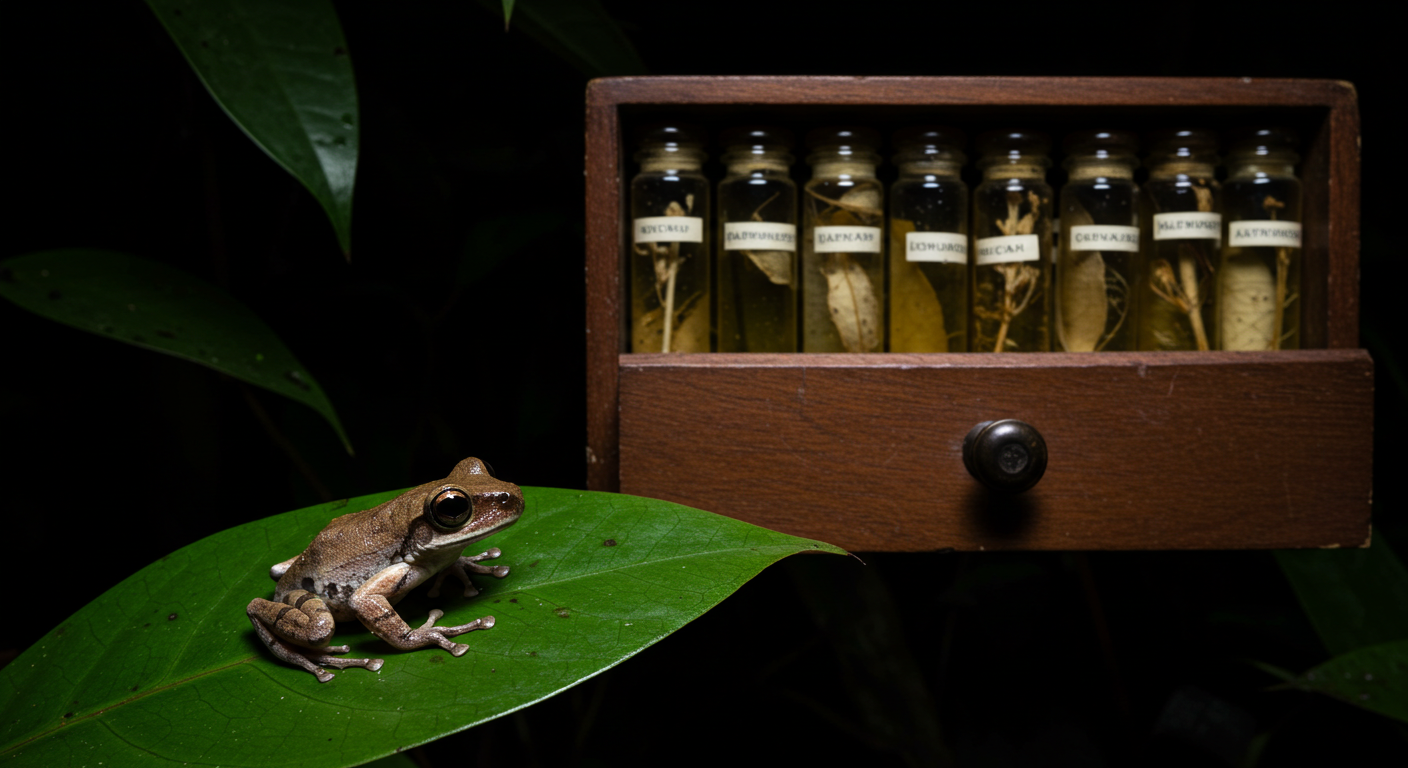
A Frog Ecuador Hears Every Night Hid Behind a Century-Old Mistake in a London Museum Drawer
A Sound That Follows Me Home
Every night, a little after the last light drains out of the mountains, the frog begins. I hear it from the porch, from the kitchen window, from bed with the shutters half open. It isn't loud, exactly, but it's insistent—a single looping note that seems to come from everywhere in the garden and nowhere at once. I've lived with this sound for years now, long enough that silence on a rare quiet night feels like an absence, like a friend who didn't show up.
At first the call was just part of the ambient texture of a new life in Ecuador, background noise to homesickness and unfamiliar bus routes and learning which vegetables to trust at the market. But somewhere along the way it stopped being background. I started listening for it. I started wondering, in that idle way expats wonder about the small mysteries that accumulate around them, what exactly was making that sound—and why no one seemed to have a straightforward answer.
Chasing a Name for the Voice in the Dark
I asked neighbors first, the way you ask about anything you don't understand in a new country. Answers came easily and disagreed with each other just as easily. One neighbor was certain it was a particular tree frog common to the region. Another shook her head and said no, that one sings differently—this is something else, something smaller and shyer. A local guide I met on a hike offered a third name entirely, delivered with total confidence and no citation beyond his own years in the hills.
I brought the question to a naturalist who leads birding tours nearby, thinking he might settle it. He listened to my clumsy imitation of the call, tilted his head, and said it could be one of several species—that without seeing the animal itself he wouldn't want to guess. It was, he admitted, a notoriously tricky call to place. I wasn't conducting research. I was simply an amateur with an obsession, collecting shrugs and half-answers the way other people collect stamps.
A Thread Back to London
It was through this same naturalist, over a second cup of coffee, that I first heard the story—and I want to be clear that this is exactly what it is: a story, told to me secondhand and never verified against any museum record I've personally seen. As the tale goes, a specimen collected in this region generations ago made its way, as so many did in the era of colonial-era natural history collecting, into a museum drawer in London. There, according to local lore, it sat mislabeled for decades, filed under the name of a different, better-known species, its true identity lost somewhere between a hasty field note and an overworked cataloguer's desk.
I have no way of confirming any part of this. I don't know the museum, I don't know the species, and I don't know if the story has been embellished with each retelling or whether it holds even a kernel of documented truth. What I can say is that it has lodged itself in my imagination as a kind of parable. A frog collected in one place, misnamed in another, its real story quietly overwritten by an assumption made far from where it actually lived. It's hard not to hear an echo of my own situation in that: a person who arrived somewhere and was promptly, gently, mislabeled by everyone's best guess—myself included.
What the Mistake Reveals
I think about archival errors more than I probably should. A single mislabeled drawer can obscure a species' true range, its true call, its true self, for a hundred years, simply because someone in a hurry trusted the wrong assumption. Nobody meant harm. Nobody was even careless in any dramatic sense. It was just an ordinary mistake that hardened, over time, into something that looked like fact.
Expat life has taught me something similar about identity. You arrive somewhere new and people file you under whatever category is closest at hand—tourist, retiree, remote worker, runaway—and the label sticks whether or not it was ever accurate. You start, in small ways, to answer to it. As the story about the frog goes, the mistake wasn't malicious, just convenient, a placeholder that nobody got around to correcting. I don't know if that's literally true of any actual specimen in any actual museum. But it feels true of something.
Living With an Unresolved Mystery
The frog is calling again tonight, the same note it has offered every evening since I first noticed it, indifferent to whether I have ever learned its name. I used to think identifying it would resolve something, that a clean scientific answer would let me set the question down. Now I'm less sure that was ever the point.
There is a particular kind of peace in letting a mystery stay a mystery, in accepting that some sounds—and some parts of your own story—will not resolve into tidy labels no matter how many people you ask. The frog sings. The story of the London drawer sits somewhere between memory and myth. And I sit on the porch, an expat still being sorted out by the world and still sorting the world out in return, listening to a voice in the dark that neither of us has quite managed to name.