A Chance Find in the Loja Hills: Whispers of Petroglyphs and Pre-Inca Trade
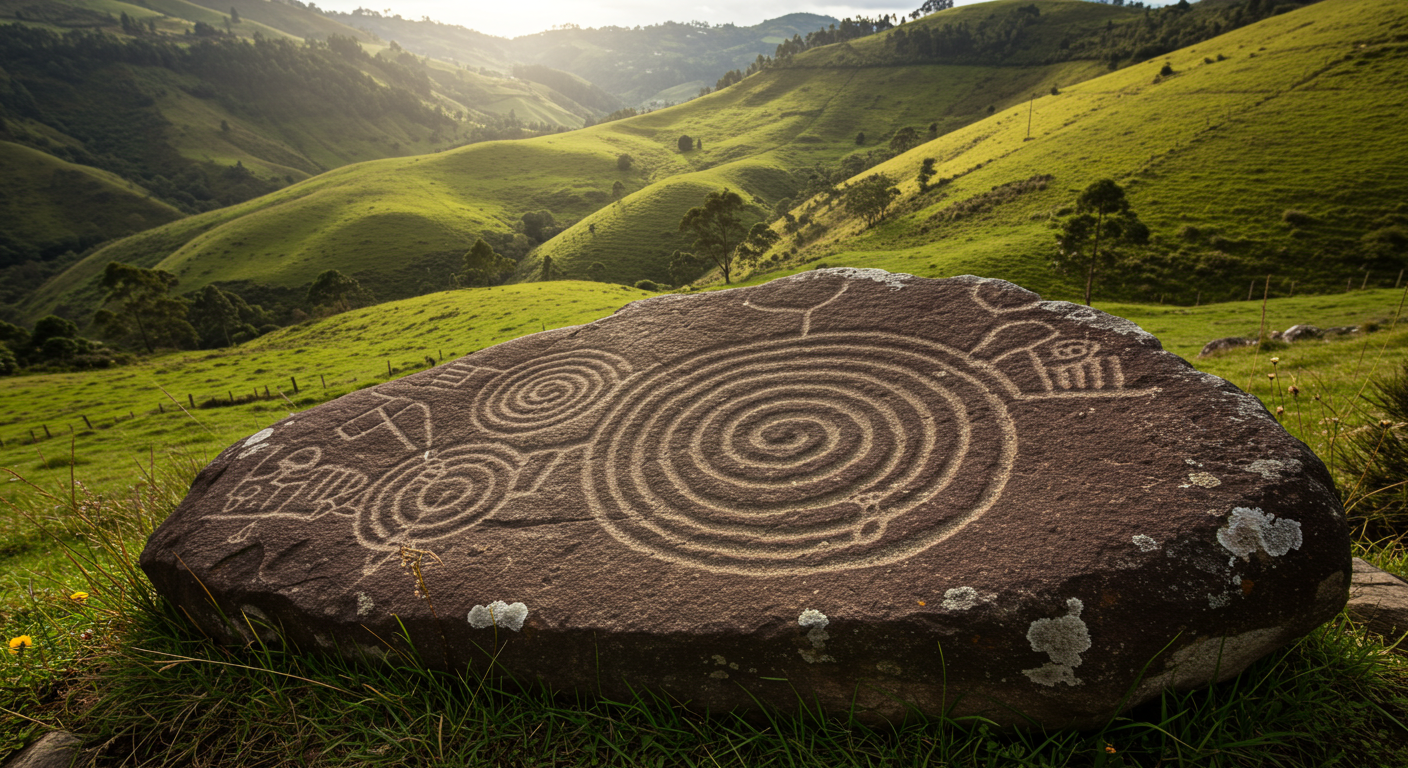
Loja province rarely makes it onto the well-worn expat trail through Ecuador. It sits south of Cuenca, closer to the Peruvian border than to the country's more photographed highlands, and it tends to draw travelers who are already looking for something quieter. That was more or less how I ended up there myself, on a slow drive through the hills outside the provincial capital, when a conversation at a roadside stop turned unexpectedly toward archaeology.
Someone mentioned, almost in passing, that there was a dig happening nearby, connected somehow to a mining project. I hadn't expected to hear those two words in the same sentence. Mining and archaeology aren't a pairing most people associate with each other, and certainly not in a region better known for its coffee and its distance from Ecuador's more famous ruins. I want to be upfront that what follows isn't a report from an archaeological desk. It's an account of curiosity, secondhand conversation, and the particular experience of brushing up against a story that hasn't been fully told yet.
What's Being Said About the Find
The details I heard were fragmentary, and I want to treat them that way rather than dress them up as confirmed fact. People in the area spoke of petroglyphs uncovered during survey work, and of some evidence suggesting a trade connection between the highlands and the coast, with a date somewhere around 1440 AD circulating in conversation. That timeframe would place the find in the period just before or during the early expansion of Inca influence into the region, which is part of what made it feel intriguing to me as an outsider.
I can't confirm a site name, a company, or a dating method. What I encountered was local talk, the kind that moves through a community faster than any formal report ever could. It's worth noting how rarely this part of Ecuador features in the broader narrative of pre-Columbian history, which tends to gravitate toward Cuzco and the core Inca heartland. Even an unverified rumor of highland-coast exchange happening on Loja's own terms felt like a small corrective to that imbalance.
Why Mining and Archaeology Intersect in Ecuador
Setting the specifics of this particular case aside, the general pattern is real and worth understanding. Mining projects in Ecuador often trigger archaeological surveys as part of environmental and permitting requirements before ground can be broken. Companies are sometimes obligated, or find it strategically useful, to fund cultural heritage assessments in areas slated for extraction.
This creates an uneasy but sometimes productive overlap between extractive industry and cultural preservation. Surveys conducted ahead of mining work can surface sites that might otherwise go unnoticed for decades, simply because no one had reason to dig there. At the same time, the relationship isn't without tension. Heritage advocates and local communities can be wary of extractive companies shaping the pace or framing of archaeological discovery, even when the intentions are procedural rather than self-serving. It's a dynamic that plays out across Ecuador's resource-rich provinces, and Loja, as I learned, is apparently no exception.
The Expat Lens: Living Near Layers of History
There's something disorienting about living in a place long enough to start hearing its half-told stories. As a foreign resident, I'm aware that I arrive with none of the inherited context that locals carry. When people spoke about the dig, they spoke with a kind of quiet pride, even amid the uncertainty of what exactly had been found. A shop owner told me her grandfather used to talk about strange markings on rocks up in the hills, long before any mining company showed interest in the area.
Conversations like that reminded me how much history in a place like Loja lives outside of formal documentation, passed along in fragments at kitchen tables and roadside stalls. My role, as I see it, isn't to adjudicate what's true. It's to listen, stay humble about what I don't know, and resist the urge to package someone else's inherited story into a tidier narrative than it deserves.
Petroglyphs, Trade Routes, and the Pre-Inca Imagination
I'll admit that once the idea of a highland-coast trade network took hold in my mind, it was hard not to imagine what that exchange might have looked like. This section is speculation, not history, and I want to flag it clearly as such. But it's worth remembering that the broader Andean world, long before European contact, was threaded with trade routes connecting different ecological zones, from coastal fishing communities to highland agricultural settlements.
If petroglyphs really do mark some kind of exchange route through this part of Loja, it would fit a pattern known elsewhere in the Andes, where goods like salt, shells, textiles, and metals moved across dramatic changes in elevation and climate. None of that confirms anything about this specific site. But it does make the rumor easier to imagine as something more than idle talk, even if it remains, for now, exactly that.
Uncertainty as Part of the Story
I want to be plain about the limits of what I actually know. I couldn't confirm an official site name, a research team, or even the identity of the mining company said to be funding the work. No published findings crossed my path during my time there. What I have is an impression, gathered from conversation, of a discovery still working its way from rumor toward documentation.
In a strange way, that gap felt like its own kind of story. Living abroad often means encountering things before they're fully formed, catching a place mid-sentence rather than waiting for the official version. I'd rather share that honestly than pretend to a certainty I don't have.
Closing Reflection: Loja's Quiet Layers
I think back to that roadside conversation often, not because I learned anything definitive, but because it reminded me how much history sits just beneath the surface in places that rarely get written about. Loja doesn't carry the same weight in Ecuador's historical imagination as the Inca strongholds further north, but that may say more about who's been telling the story than about what actually happened there.
I don't have a tidy conclusion to offer, and given how much of this remains unconfirmed, I'm not sure one would be honest. What I can say is that I left those hills with a stronger sense that Loja's layers, quiet and half-uncovered as they are, deserve more attention than they usually get.