Taza Dorada at Uncertain Milestones: Tracing Ecuador's Specialty Coffee Contest Through Its Documented History
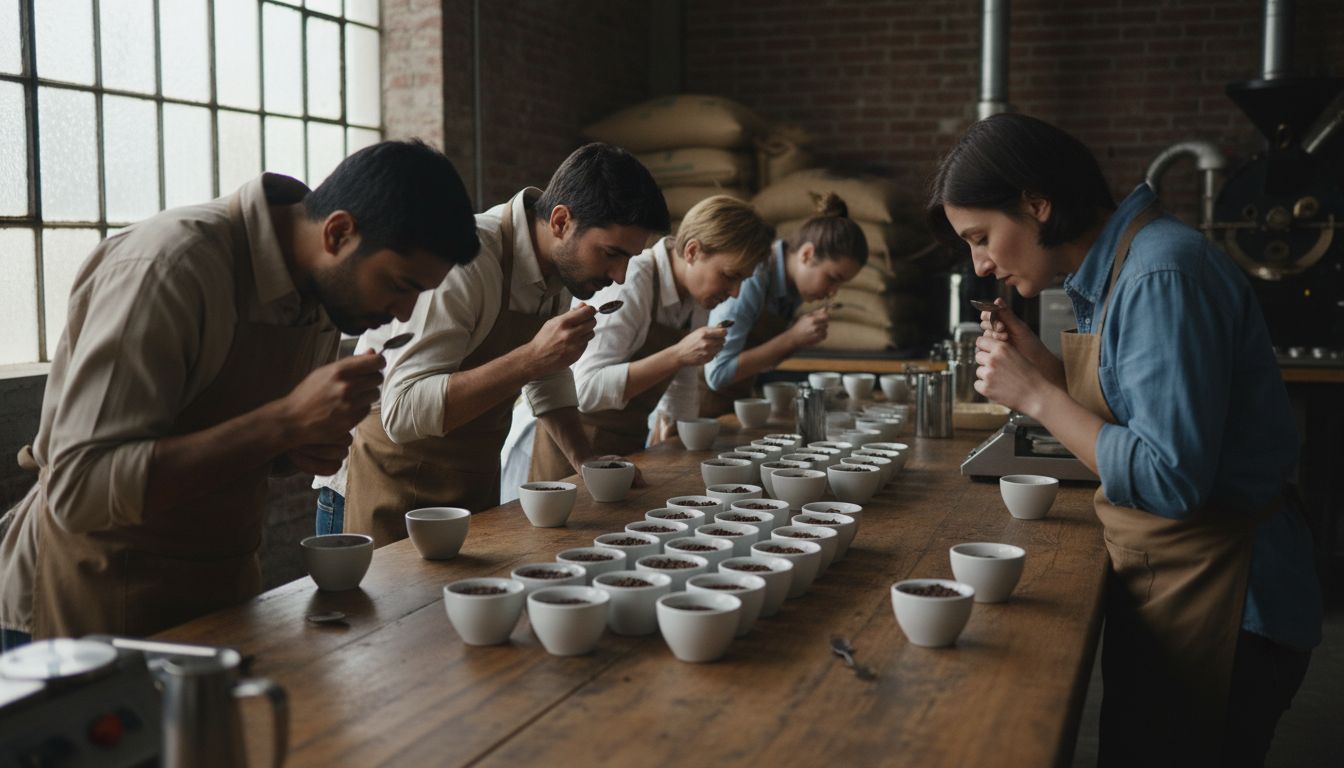
A recent framing making the rounds describes Taza Dorada's "20th edition" and a chase for "80 points" among Ecuador's specialty coffee growers. Available reporting and institutional sources don't corroborate this specific framing. What can be documented is a competition that has run under various forms since at least 2007, organized by Anecafé, Ecuador's national coffee growers association, with support from government ministries in different years. This piece reconstructs that documented history and the broader quality trajectory of Ecuadorian specialty coffee, rather than confirming a specific edition count or point threshold. Readers seeking precise, current figures on edition number or scoring benchmarks should verify directly with Anecafé.
What Taza Dorada Is and Why It Matters
Taza Dorada, or "Golden Cup," is Ecuador's flagship specialty coffee competition. Its stated purpose is to identify and reward the country's top-scoring specialty Arabica lots, giving small producers a platform and, ideally, access to premium buyers. Anecafé has served as the lead organizing body, with government ministries — historically MAGAP, more recently the Ministry of Production, MPCEIP — providing co-promotion and regulatory backing in various editions.
A recurring feature across the competition's documented history is the use of international judging panels. Over different years, judges have come from Japan, the United States, Colombia, Argentina, Germany, Korea, Taiwan, Australia, and Costa Rica. Samples are reportedly coded numerically so that judges evaluate coffee blind, without knowing the producer's identity — a structure organizers and government communications have pointed to as lending credibility to the results.
A Look Back: The 2014 Edition and Its "Historic" Record
According to a 2014 government press release, that year's competition produced a winning score of 89.20 points, awarded to a producer representing ACOPOC, Elizabeth Ríos, from Loja province. The release described more than 30 producers participating, with judges drawn from five countries. It's worth noting this account comes from a single institutional source, a ministry communication with promotional framing typical of government press releases, and no independent verification of the scoring methodology or results appears in the available record. The claim of a "historic record" rests on the organizer's own characterization.
The 2016 Robusta Edition: A Different Kind of Specialty Push
A separate, earlier effort in 2016 focused specifically on robusta coffee, a variety more commonly associated with lower-grade commercial blends than specialty markets. Industry coverage from that period framed the event as an attempt to build a specialty niche for robusta in Ecuador, distinct from the Arabica-focused competitions that dominate most Taza Dorada coverage. This suggests the "Taza Dorada" name has been applied to more than one distinct competition format over the years, which may partly explain confusion around edition numbering.
2020: Record Participation Amid Rising Quality Standards
By 2020, government communications describe a competition that had grown considerably: 114 producers participated, described at the time as a record for the event, and 40 samples scored above 86 points in the final judging stage. Winning provinces were again concentrated in Loja, Pichincha, and Carchi, a pattern consistent with earlier editions. International judges that year came from seven countries, reinforcing the event's positioning as a globally judged competition rather than a purely domestic exercise.
Quality Trajectory: From Low-80s to Low-90s Over a Decade-Plus
Later reporting suggests a broader upward trend in national quality benchmarks, with figures cited moving from roughly 65.50–82 points in 2007 to a range of 88.17–91 points by 2025. A particularly notable data point is a 2022 lot from Quilanga that reportedly scored 92.65 points, with an auctioned pound from that lot selling for $144.50. Many observers in the coffee trade point to this progression as evidence that Ecuador's specialty segment has matured considerably since the competition's early years, though it's worth treating these figures as directional rather than precisely verified, since they come from a mix of institutional and trade-press sourcing rather than a single audited record.
The Paradox: Rising Quality, Shrinking Footprint
Alongside these quality gains sits a starker structural story. Ecuador's cultivated coffee area has fallen dramatically, from a reported peak of 521,000 hectares in 1994 to roughly 33,926 hectares in more recent estimates. Domestic production, estimated around 150,000 quintales annually, falls well short of domestic demand, estimated near 300,000 quintales, meaning Ecuador reportedly imports coffee to meet local consumption even as its specialty exports draw international attention.
A recurring concern in industry coverage centers on the structural pressures behind this decline: younger workers migrating toward mining and other sectors rather than coffee farming, an aging farmer population, and limited access to credit or technical support for modernizing production. These are described as long-standing challenges rather than a sudden crisis, but they form an important backdrop to any narrative about rising competition scores.
Who's Driving the Specialty Niche
Small producer associations appear central to whatever specialty success Ecuador has achieved. Groups like Fapecafes and Procafeq are frequently cited as key organizers connecting smallholder farmers to premium buyers. Café oro, Ecuador's premium green coffee grade, has reportedly commanded prices exceeding $500 per quintal, with Fapecafes said to pay producers in the range of $510–525 per quintal, well above commodity-grade pricing.
Export patterns cited in trade reporting suggest a strong European orientation, with Fapecafes reportedly sending around 43% of its exports to France, alongside shipments to Italy and Germany. More broadly, the coffee sector is described as supporting roughly 13,000 direct jobs and touching some 105,000 families nationally, underscoring that despite the shrinking cultivated footprint, coffee remains economically significant for a meaningful portion of Ecuador's rural population.
Looking Ahead: EU Deforestation Rules and What's at Stake by 2027
A further pressure point on the horizon involves new European Union import rules requiring deforestation-free sourcing, expected to take effect in 2027. For exporters like Fapecafes that rely heavily on European markets, this regulatory shift represents both a potential opportunity, rewarding producers who can document sustainable land use, and a compliance burden for smaller associations with limited administrative capacity. How Ecuador's specialty coffee sector adapts to these requirements may shape whether its recent quality gains translate into durable market access, or whether smaller producers face new barriers to reaching their highest-value buyers.
Taken together, the documented history of Taza Dorada and Ecuador's specialty coffee sector tells a story of incremental, hard-won quality improvements set against genuine structural decline in production capacity. Whatever the precise edition count or scoring threshold behind the framing that prompted this piece, the underlying trend, a smaller but increasingly premium-focused coffee sector, appears well supported across multiple years of reporting.