Peru's Pollo a la Brasa Officially Lands in Quito — a City With 1,500 Roast-Chicken Rivals
Peru's Pollo a la Brasa Officially Lands in Quito — a City With 1,500 Roast-Chicken Rivals
Quito has no shortage of roast chicken. So when a new restaurant called Pollo Republic opened its doors on July 28, 2026, billing itself as the city's first 'official' Peruvian-style pollería, it raised an obvious question: does the capital really need another chicken spot?
A New 'Official' Contender Enters Quito's Chicken Wars
Pollo Republic launched with messaging that positions it as something distinct from the countless asaderos already lining Quito's streets. The restaurant describes itself as the city's first 'official' Peruvian-style pollería, a phrase worth pausing on. The word 'official' here appears to function as a branding and marketing claim rather than any kind of verified certification from a culinary authority, trade body, or government agency. No certifying body was identified in coverage of the opening, so the label is best read as promotional positioning rather than an authenticated designation.
A Market Already Flooded With Roast Chicken
Local press coverage of the opening cited a striking figure: roughly 1,500 to 1,510 pollo asado and roast-chicken restaurants already operating in Quito. That number traces back to registry citations referenced in news reporting rather than a confirmed dataset from Ecuador's national statistics institute or municipal government. Readers should treat the figure as an approximate, press-sourced estimate rather than an officially audited count.
Even treated cautiously, a number in that range suggests an unusually dense concentration of similar businesses. A recurring concern in markets this saturated is differentiation — with so many nearly identical offerings, what makes any single restaurant worth choosing over the one next door becomes the central competitive question.
The Peruvian Roots of Pollo a la Brasa
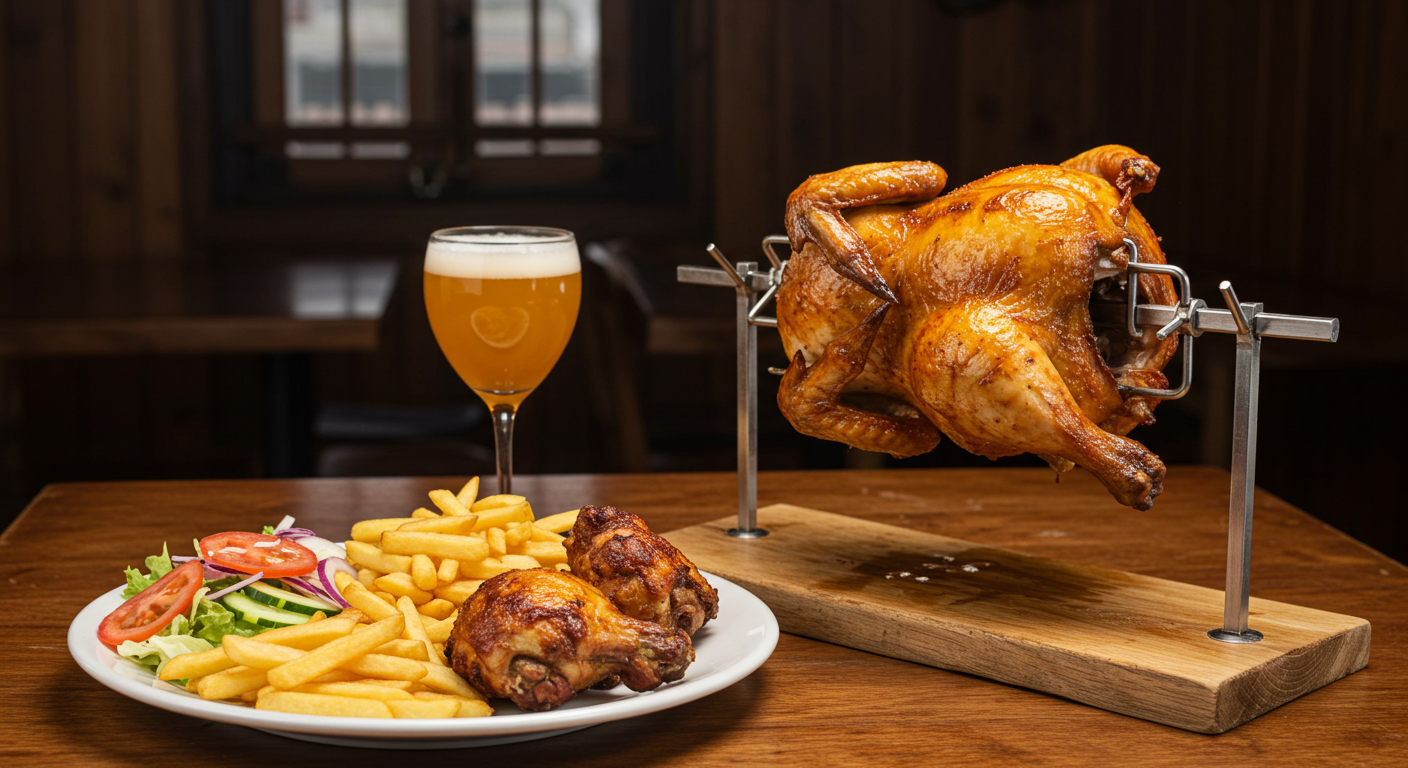
Pollo a la brasa has a well-documented origin story. The dish traces back to mid-20th-century Peru, where it developed into a distinctive preparation: chicken marinated in a specific blend of spices, then slow-roasted on a rotating spit over wood or charcoal. Over subsequent decades it became one of Peru's most widely exported culinary staples, appearing in Peruvian restaurants across Latin America, North America, and beyond.
This history is relevant to Pollo Republic's positioning. Generic roast-chicken offerings common throughout Quito typically differ from the traditional Peruvian method in marinade composition, roasting technique, and accompanying sides. Whether a given restaurant's preparation faithfully reflects that Peruvian tradition or simply borrows the name is something individual diners are better positioned to judge than any press release.
Why Enter an Oversaturated Market?
Entering a category with well over a thousand existing competitors is, on its face, a difficult business proposition. A plausible strategy for a new entrant is to compete not on chicken generally but on a narrower claim: authenticity, recipe provenance, and national identity. By framing itself as genuinely Peruvian rather than a local approximation, Pollo Republic appears to be betting that a segment of Quito diners cares about the distinction between generic roast chicken and the specific culinary tradition the dish originated from.
Whether that differentiation is enough to carve out sustainable market share remains an open question. A market already home to well over a thousand chicken restaurants leaves little room for error, and cultural-authenticity branding alone does not guarantee consumer loyalty in a category driven heavily by price and convenience.
Incidental Narrative Color: The Fujimori Timing
At least one outlet noted that Pollo Republic's opening date coincided with the timing of Keiko Fujimori's inauguration as president of Peru. This connection appears to be incidental narrative color rather than a substantive news link — the kind of coincidental timing that makes for an attention-grabbing detail in a short business item, not evidence of any coordinated political or diplomatic significance. Readers should be cautious about reading deeper meaning into what looks like a promotional coincidence.
What This Means for Quito Diners
Stripping away the framing, here's what's actually established: a new restaurant calling itself Pollo Republic opened in Quito on July 28, 2026, positioning itself as the city's first 'official' Peruvian-style pollería. What remains unverified includes both the precise scale of Quito's existing chicken-restaurant market — commonly cited at around 1,500 locations but not confirmed by a named statistical agency — and the meaningfulness of the 'official' label itself.
For diners, the practical takeaway is straightforward: whether Pollo Republic represents a genuinely novel culinary offering or simply repackaged competition in an already crowded field is best judged by trying it. Curious readers can look for the new pollería's Quito location through local restaurant listings and delivery platforms as it establishes itself in the city's dense roast-chicken landscape.