What Happens When AI Systems Disagree With Each Other?
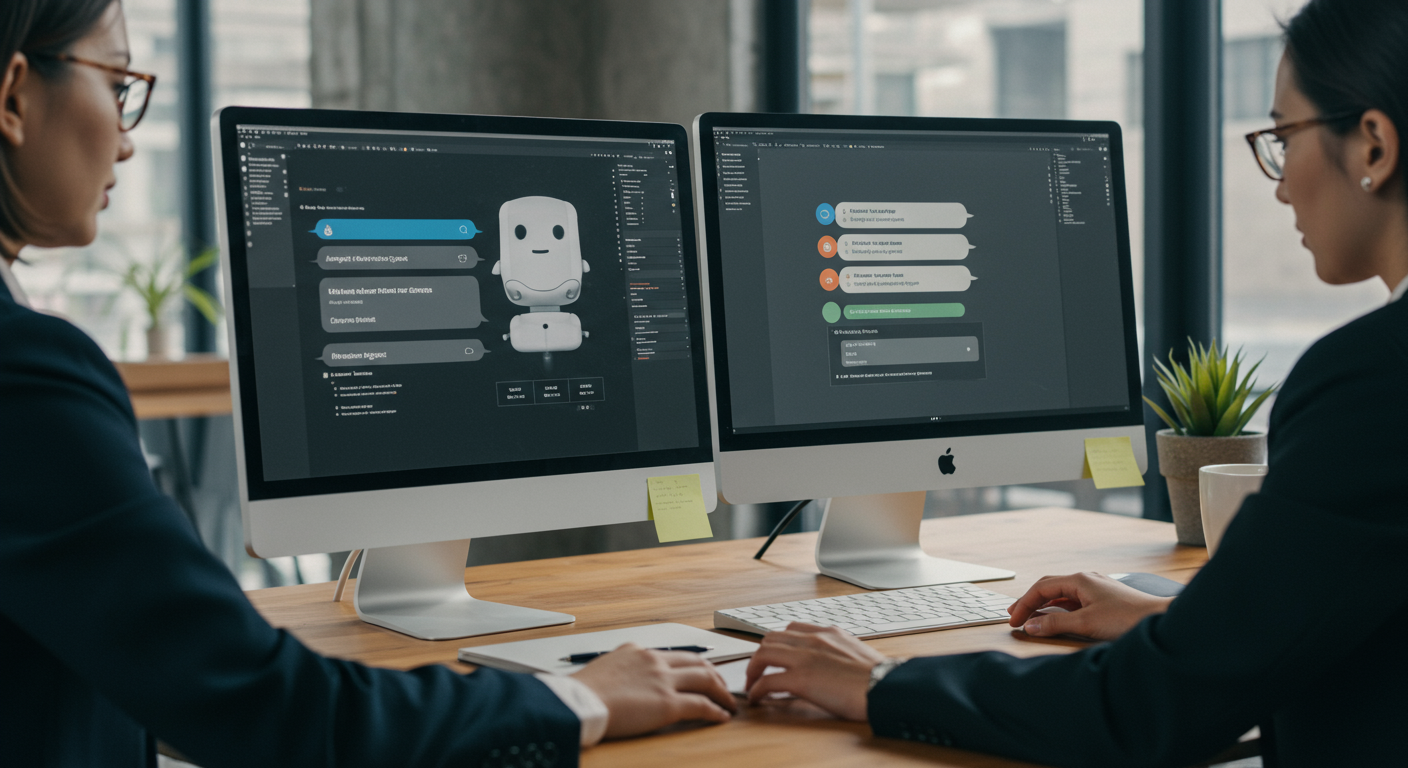
When two AI systems give different answers to the same question, it can feel like something has gone wrong. In practice, disagreement is often normal. These systems are built with different training data, model architectures, tuning methods, prompts, tools, and response settings. Even the same model can produce different answers across runs when generation is probabilistic.
That matters because AI disagreement is not just a curiosity. It can reveal uncertainty, expose brittle reasoning, and help operators decide when a task needs more evidence or human review. But disagreement is not a truth machine. One model criticizing another can be useful in some settings, yet it does not eliminate the need for outside checks.
Why AI systems disagree in the first place
Some disagreements are superficial. Two systems may express the same idea in different words, or emphasize different details while still pointing to the same conclusion. More important are substantive disagreements: conflicting facts, different judgments, or incompatible recommendations.
Those deeper conflicts can arise for many reasons. Models learn from different slices of the world. They may be optimized for different objectives, such as helpfulness, harmlessness, speed, or concise output. One system may have retrieval access to current information while another relies mainly on training-time knowledge. Prompt wording can also shift answers dramatically, especially on ambiguous or underspecified tasks.
There is also a statistical element. Modern generative systems do not always produce a single fixed response. Sampling choices can change which answer appears, which means disagreement can occur not only across competing models but also across repeated runs of the same model.
What disagreement can tell us
A disagreement between systems is often best treated as a signal that a question is ambiguous, difficult, or underdetermined. It can point to hidden assumptions in the prompt, unclear definitions, missing context, or edge cases that simpler tests miss.
That makes disagreement valuable for debugging. If one model says a policy is allowed and another says it is not, the conflict may reveal that the instruction itself is vague. If one system gives a confident answer and another hesitates, that may indicate poor uncertainty calibration. In other cases, conflicting outputs can surface bias, shortcut reasoning, or hallucinated facts.
At the same time, agreement should not be confused with correctness. Multiple systems trained on similar data or optimized with similar incentives can converge on the same wrong answer. Consensus among models may reflect shared blind spots rather than truth.
When AI-vs.-AI critique is actually useful
There are legitimate research directions in which one AI system helps evaluate another. Model-based critique, ranking, and response comparison can improve outputs in some domains, especially when the task has enough structure to make errors visible.
One notable example is process supervision. As OpenAI has argued in its work on mathematical reasoning, judging intermediate reasoning steps can outperform evaluation that looks only at the final answer. In math and related tasks, that can help catch mistakes earlier instead of rewarding lucky guesses.
Another example is Constitutional AI. Anthropic describes this approach as using AI-generated feedback constrained by explicit principles. The point is not to let one model improvise moral authority over another, but to channel critique through a predefined set of rules. That can make feedback more consistent than unconstrained model opinion.
Used carefully, these approaches suggest that AI-on-AI evaluation can support quality control, red-teaming, and iteration. It can help surface weak reasoning and improve consistency, especially during development.
The limits of letting AI systems police each other
The biggest problem is shared failure modes. If two models are trained on overlapping data, shaped by similar benchmarks, or rewarded for similar patterns, they may reproduce the same hallucinations and shortcuts. In that case, having one model check another does not create an independent safeguard. It can simply automate agreement around the same mistake.
That is why researchers and policy analysts have been cautious about treating AI self-oversight as sufficient, especially in safety-critical settings. Stanford Human-Centered Artificial Intelligence has warned that AI systems may not be able to police themselves, and Nature has reported similar concerns about self-critique and oversight. A model may be good at sounding persuasive while still missing subtle factual or procedural errors. Majority vote among models can improve robustness in some narrow tasks, but it does not guarantee truth, legality, or safety.
There is also a governance issue. If the same class of systems is generating, critiquing, and approving outputs, operators may mistake internal coherence for external reliability. That is a risky shortcut in domains like health, finance, law, infrastructure, or public decision-making.
What operators should do when systems conflict
In real-world use, disagreement should function as an operational trigger. If two systems diverge on a meaningful question, that can be a cue to escalate for human review, retrieve additional evidence, run targeted tests, or fall back to a more conservative workflow.
This is where risk management matters more than model theatrics. The National Institute of Standards and Technology AI Risk Management Framework offers a practical lens: identify where disagreement matters, measure how often it happens, govern the response procedures, and monitor the system over time. In other words, disagreement should be tracked as a risk signal, not treated as a novelty.
The right response depends on the stakes. For low-risk tasks, automated tie-breaking or secondary checks may be enough. For high-stakes uses, disagreement should raise the bar for confidence and trigger outside validation. The more serious the consequences, the less acceptable it is to let one opaque system overrule another without human accountability.
The bigger takeaway
When AI systems disagree, the most useful interpretation is usually not that one of them has revealed the truth. The more valuable reading is diagnostic: the task may be ambiguous, the evidence may be thin, or the models may be exposing each other's weaknesses.
That makes disagreement a useful tool for auditing, robustness testing, and workflow design. But it works best when the systems are genuinely diverse, the escalation rules are explicit, and humans remain responsible for the final call when the stakes are high.
So what happens when AI systems disagree with each other? Sometimes they help reveal uncertainty. Sometimes they expose brittle reasoning. Sometimes they simply mirror each other's limitations in different words. The lesson is not to trust the loudest model or the majority. It is to use disagreement as a prompt for better evidence, better procedures, and better oversight.