The Pentagon’s FY27 Autonomy Push: What Is Confirmed and What Still Needs Proof
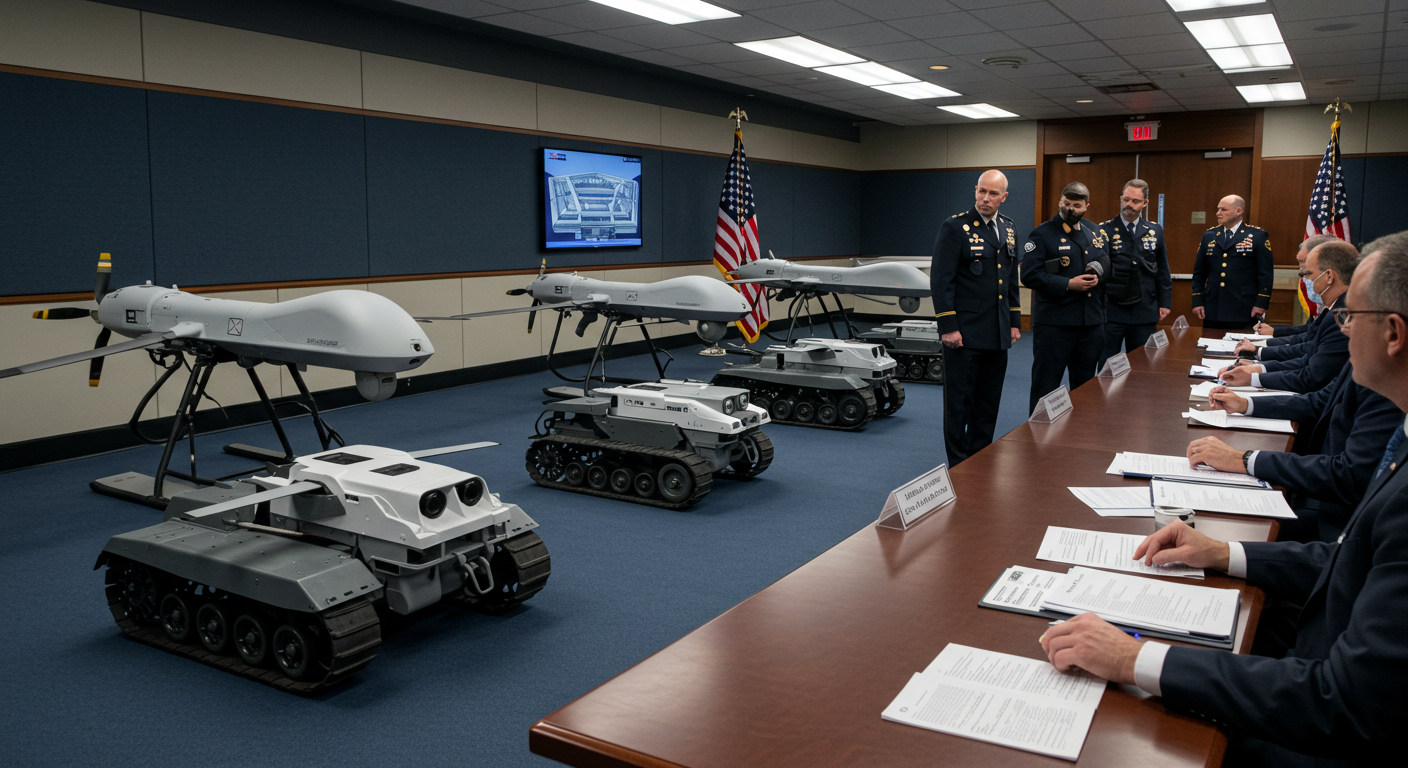
Two striking claims are circulating about the Pentagon’s fiscal year 2027 planning: first, that the Defense Department is putting $55 billion behind autonomous warfare, and second, that it is creating a new four-star robotics command. Both are plausible enough to draw attention. But based on the sources reviewed here, neither should be treated as established fact without direct confirmation from primary U.S. government documents.
That distinction matters. In defense budgeting, broad labels such as “autonomous warfare” often work more as narrative shorthand than as formal line items. Likewise, what is described publicly as a new “command” may turn out to be a task force, coordinating office, service-level initiative, or conceptual reorganization rather than a statutory four-star command with clearly defined authority.
What the FY27 claim appears to mean
The $55 billion figure may refer to a combination of programs related to autonomy, robotics, unmanned systems, artificial intelligence, command and control, targeting, logistics, and supporting infrastructure. If so, the number would not necessarily represent a single Pentagon budget category. It could instead be an external estimate built from multiple accounts spread across the military services and defense agencies.
That would not be unusual in national security reporting. Large topline figures are often created by combining procurement, research and development, operations, software, and platform spending that support overlapping strategic goals. But if that is the method, the calculation needs to be shown clearly before the total can be presented as a definitive Pentagon “bet” on autonomous warfare.
What primary budget documents would need to show
The most important place to verify the spending claim is the Defense Department comptroller’s budget material. If the $55 billion total is official, it should appear in budget books, justification documents, or accompanying summaries in a way that makes the figure traceable. If it does not appear directly, then the key question becomes whether the total is an outside aggregation and, if so, which program elements were included.
That methodology matters because the final number could shift significantly depending on what is counted. One tally might group drones, autonomy software, AI-enabled sensing, battle management, and counter-drone systems together. Another might exclude supporting command-and-control systems or ongoing legacy unmanned programs. Without those boundaries, a dramatic headline figure can sound more precise than the underlying material really is.
It is also important to separate genuinely new FY27 spending from programs that are simply being continued, rebranded, or grouped differently for strategic messaging. A large number may reflect a real shift in emphasis, but it may also reflect a new way of describing money already in the pipeline.
What is known about any “robotics command”
The second claim — that the Pentagon is creating a new four-star robotics command — requires even more careful verification. A move at that level would normally leave a visible official trail through Pentagon announcements, leadership statements, testimony, organizational material, or congressional documentation.
Based on the sources identified for this draft, the best places to confirm such a development are Defense Department releases and congressional records. Those materials would help answer several basic questions: Is this a formal new command, a proposed command, or only a concept under discussion? Would it be a unified command, a service component, or an internal management structure? And is there actually a four-star billet attached to it?
Those distinctions are not semantic. In military bureaucracy, “command” can mean very different things depending on statute, chain of command, and resources. A coordination hub for autonomy programs is not the same as a new four-star institution with lasting authority across the department.
Why Congress would likely matter
If a true four-star robotics command were being established, Congress would likely appear somewhere in the story. Major organizational changes, senior billets, and associated funding typically leave some paper trail through authorization or appropriations processes, hearing testimony, or explanatory statements. Congress.gov is therefore a critical check on whether the idea exists as a formal proposal rather than as speculation or loose shorthand.
Even if legislation were not required for every internal realignment, a change significant enough to justify the phrase “new four-star robotics command” would usually produce evidence beyond trade reporting alone.
What trade coverage can add
Defense trade outlets are still useful here, especially for showing how officials, contractors, and analysts interpret autonomy-related spending and organizational change. Publications such as Defense News, Breaking Defense, and C4ISRNET can help identify emerging themes, disputes over definitions, and the significance of budget choices across the services.
What they cannot do on their own is conclusively prove the central claims. If trade reporting describes a robotics command or cites a large autonomy total, that reporting still needs to be reconciled with official budget books, Pentagon statements, and congressional materials. Any mismatch between the two should be treated as the story, not glossed over.
What can be said with confidence right now
There is little doubt that autonomy, unmanned systems, military AI, and machine-assisted command functions are becoming more central to Pentagon planning. That broad strategic direction is well established. What remains less certain, based on the source base available for this draft, is whether FY27 includes an officially identified $55 billion autonomy total and whether the department is actually standing up a new four-star robotics command.
Until those two points are tied directly to primary documents, the strongest responsible framing is narrower: the Pentagon appears to be deepening its focus on autonomy and robotics, but the most dramatic numerical and organizational claims still need documentary proof.
Bottom line
If future budget books or official releases show a clearly defined $55 billion autonomy portfolio and a formally proposed or approved four-star robotics command, that would mark a significant organizational and strategic milestone. If not, the headline should be understood as a blend of interpretation, aggregation, and forward-looking defense narrative rather than a settled description of Pentagon policy.