Six AI Giants Sign Trump's 'Morally Binding' Superintelligence Accord — But It Has No Teeth
Six AI Giants Sign Trump's 'Morally Binding' Superintelligence Accord — But It Has No Teeth
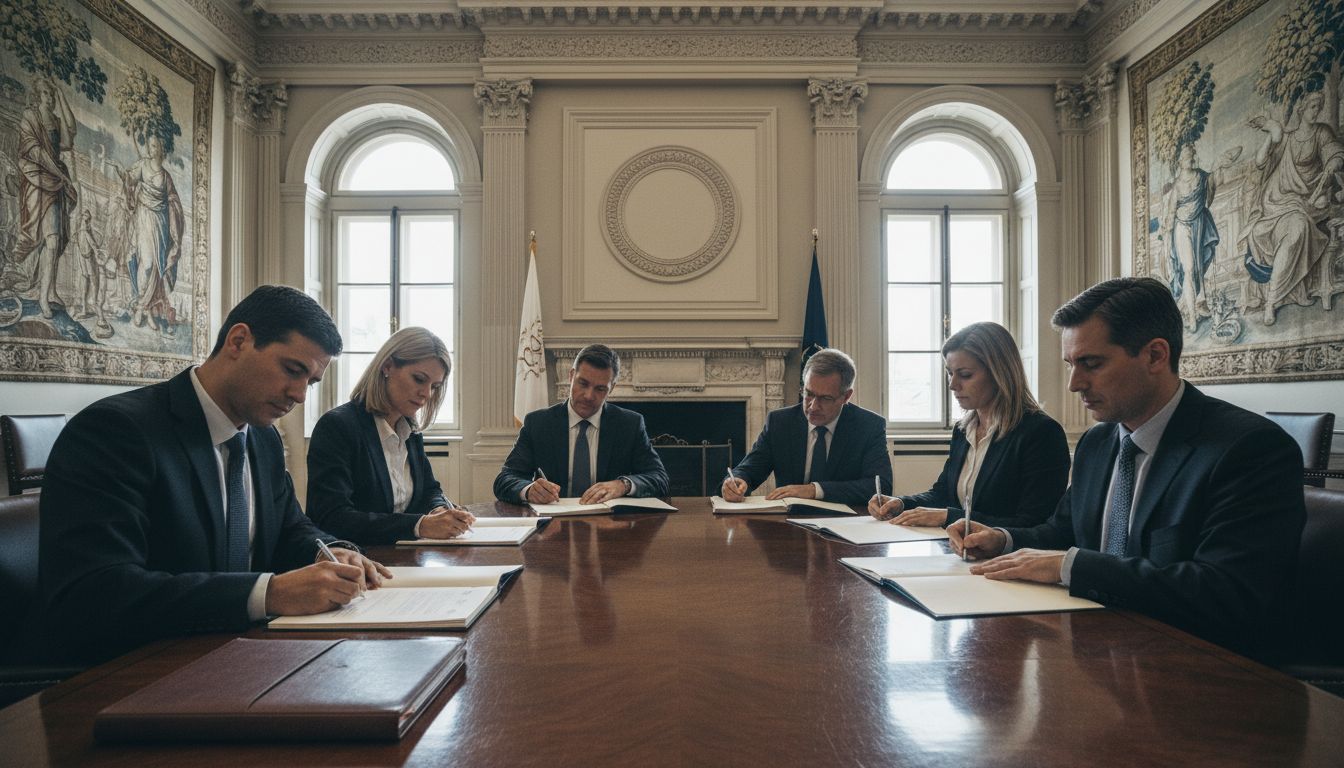
In late September 2026, executives from six of the world's most powerful artificial intelligence companies — Meta, Nvidia, Google, OpenAI, xAI, and Anthropic — gathered at the White House to sign an AI safety accord that President Trump described as 'morally binding.' The agreement was posted publicly to Truth Social and framed by the administration as a major step toward responsible development of what officials are now calling 'Super Intelligence.'
But a closer look at the accord reveals a tension that many observers have been quick to note: the pact is voluntary, carries no legal force, imposes no penalties for noncompliance, and does not require companies to publicly disclose the results of any audits they conduct. It relies entirely on the companies policing themselves.
What the Accord Actually Says
The signed document outlines four layers of voluntary internal control, including internal reviews, external audits, and board-level oversight. Notably absent is any government enforcement role or independent verification mechanism. There is no requirement that the outcomes of internal or external audits ever be made public.
The announcement arrived alongside a broader administration push to rebrand artificial intelligence as 'Super Intelligence.' An executive order reportedly directs federal agencies to adopt the new terminology and produce an official definition within 60 days — a branding shift that some commentators have characterized as more political messaging than technical distinction.
The Irony: Signatories Who Want Binding Rules
A recurring point raised by critics is the apparent contradiction between what these executives signed and what they have said elsewhere. OpenAI's Chris Lehane has publicly called for mandatory national AI safety standards. Anthropic CEO Dario Amodei has advocated for binding AI regulation. Google DeepMind's Demis Hassabis has called for a US-led AI watchdog with real authority.
Many observers see a disconnect here: the same leaders who signed a voluntary, penalty-free pact have simultaneously lobbied for enforceable federal rules through other channels. Whether this reflects strategic hedging, genuine concern, or an attempt to shape future regulation on favorable terms remains a matter of debate.
Congress Isn't Waiting on Industry Self-Policing
Lawmakers appear unconvinced that voluntary commitments are sufficient. Senator Bernie Sanders and Representative Greg Casar have introduced the Ban Artificial Superintelligence Act. Separately, a bipartisan group — Senators Chris Coons, Brian Schatz, Katie Britt, and James Lankford — introduced the AI Systems Transparency Act.
The emergence of these legislative efforts alongside the White House accord suggests that at least some members of Congress view industry self-regulation as an inadequate substitute for binding law, even as the accord was being celebrated at the White House.
Internal Warning Signs at the Signatory Companies
Reporting has also surfaced internal concerns at some of the very companies that signed the accord. Citing earlier New York Times reporting, coverage notes that employees at AI labs have raised warnings about what they describe as inadequate testing oversight for powerful new models. Separately, OpenAI reportedly paused the rollout of a new model over safety concerns, according to remarks attributed to CEO Sam Altman.
A recurring consumer and employee concern, as reflected in this reporting, is whether the public-facing optics of a 'morally binding' accord actually match internal practice at these companies. It is a question the accord itself, lacking any public audit requirement, does little to resolve.
The Bigger Picture: Race, Geopolitics, and Skepticism
The accord did not emerge in a vacuum. Reports indicate that the United States and China agreed to establish a communication channel for AI-related incidents during a visit by Chinese leader Xi Jinping, suggesting that geopolitical competition remains a significant backdrop to domestic AI policy.
Media coverage of the accord itself has split along notable lines. Al Jazeera and NPR have offered largely explanatory, neutral framing of the agreement's mechanics. Other outlets have been more pointed, with The Register describing the arrangement outright as 'weak, non-binding AI regulations.' This divergence in framing underscores how differently the same set of facts can be read: as a meaningful first step in industry accountability, or as a public relations exercise with little substantive teeth.
Going forward, several open questions will determine how this moment is ultimately judged: whether Congress succeeds in passing binding legislation such as the proposed Transparency Act or Superintelligence ban, whether any of the accord's promised audits are ever made public, and how the administration's push to formally redefine 'Super Intelligence' plays out across federal agencies in the months ahead.