NVIDIA Says Every Industrial Company Will Become a Robotics Company — GTC 2026 Makes Physical AI Central
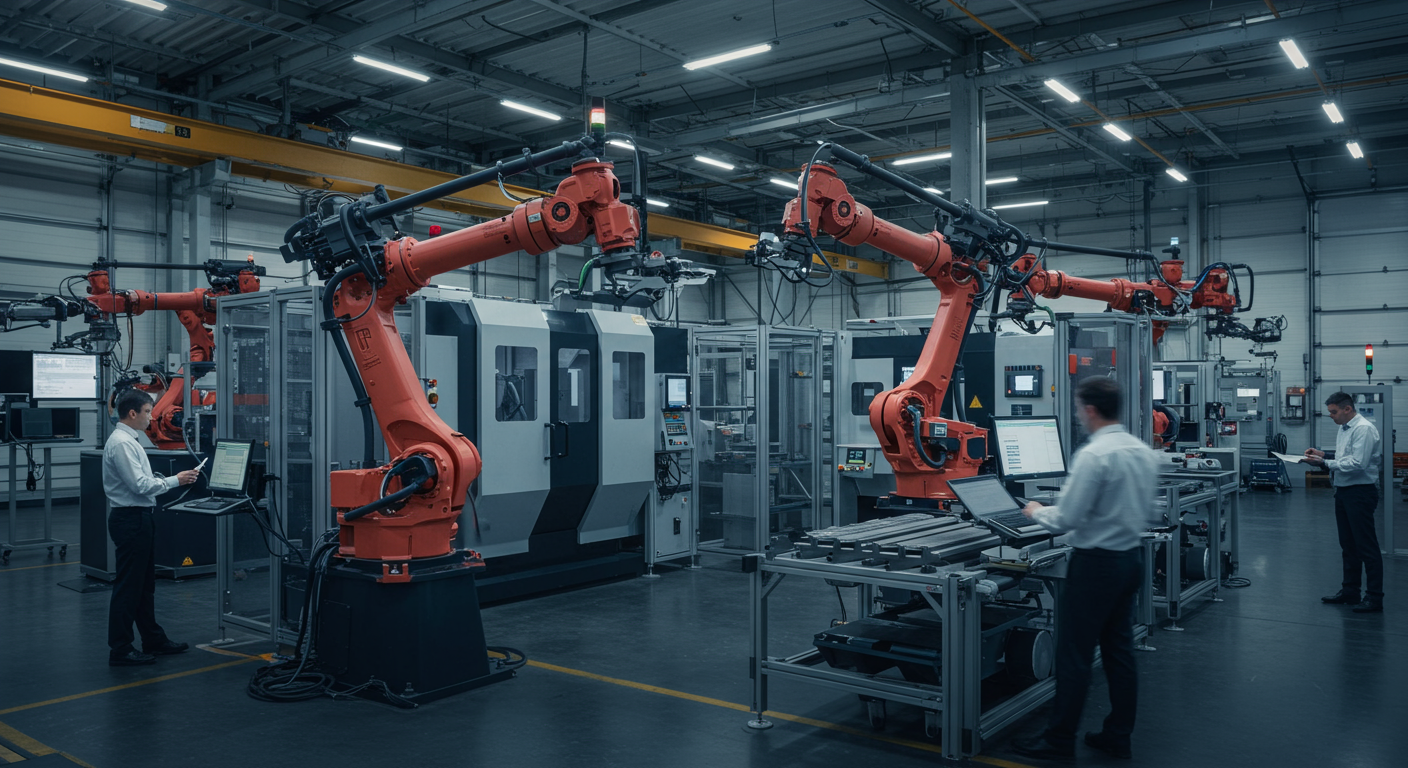
NVIDIA used GTC 2026 to make an ambitious argument: over time, every industrial company will become a robotics company. That is NVIDIA’s framing, not an established industry consensus, but the conference made clear that robotics is no longer a side story in the company’s strategy. It is increasingly central to how NVIDIA describes the future of manufacturing, logistics, warehousing, automotive systems, and other physical industries.
The importance of that message lies less in a single quote than in the structure of the event itself. GTC 2026 presented robotics, simulation, edge AI, and industrial software as connected parts of a single stack. In NVIDIA’s view, the next major phase of AI is not only about generating text, images, or code in the cloud. It is about building systems that can perceive, plan, simulate, and act in the real world.
NVIDIA’s Core Claim at GTC 2026
At the center of NVIDIA’s pitch is the idea that industrial companies will increasingly need robotics capabilities, whether or not they think of themselves as robotics businesses today. For NVIDIA, that includes companies operating factories, warehouses, vehicle fleets, infrastructure networks, and supply chains. The message is strategic: as AI becomes more capable, the line between software company, automation company, and robotics company begins to blur.
That matters because GTC 2026 treated robotics as a growth category with direct commercial implications. Rather than presenting humanoids, autonomous machines, or industrial automation as futuristic demos detached from business reality, NVIDIA positioned them as an extension of the AI buildout already underway. The company’s broader argument is that the same ecosystem powering modern AI models can also power machines operating in physical environments.
Why GTC 2026 Put Physical AI at the Center
NVIDIA has increasingly used the term physical AI to describe systems that move beyond analysis and generation into perception, reasoning, and action in real-world settings. At GTC 2026, that framing tied together several components: foundation models, accelerated computing, simulation environments, synthetic data generation, robotics software, and edge deployment hardware.
The practical narrative is straightforward. First, AI models are trained with massive computing resources. Then they are refined in simulation, where robots and autonomous systems can be tested at scale. Finally, those systems are deployed on edge hardware in factories, warehouses, vehicles, and other environments where low-latency decision-making matters. NVIDIA’s message is that industrial AI will depend on this full workflow, not on a model alone.
In that sense, GTC 2026 suggested that robotics is NVIDIA’s bridge between the current generative AI boom and a future in which AI directly reshapes physical operations. The conference treated that shift as a natural next step in the broader AI market.
What NVIDIA Actually Announced and Demonstrated
The most important takeaway from NVIDIA’s official materials was not a single robot launch but a broader platform strategy. Across GTC programming, the NVIDIA Blog, and the NVIDIA Newsroom, the company emphasized software frameworks, simulation tools, industrial AI infrastructure, and partnerships designed to help enterprises build, train, and deploy autonomous machines.
That distinction matters. Some of what appeared at GTC 2026 fits the category of concrete product or platform development, especially around compute, simulation, and deployment tools. Other parts were better understood as concept demonstrations or forward-looking showcases meant to illustrate where the ecosystem could go. NVIDIA’s robotics message was strongest when it focused on developer tools, industrial simulation, and infrastructure. It was less definitive when it shifted into broad predictions about how quickly every industrial sector will transform.
Even so, the conference reinforced a clear pattern in NVIDIA’s strategy: it wants to provide the underlying compute, software, and model-development environment for robotics in much the same way it became essential infrastructure for modern AI training.
The Industrial Playbook: Simulation, Training, Deployment
NVIDIA’s industrial pitch depends heavily on the idea that robots should be developed virtually before they are deployed physically. That puts digital twins, synthetic data, and simulation environments at the center of the process. Companies can model facilities, train systems on edge cases, and test machine behavior in software before taking on the cost and risk of live deployment.
From there, accelerated computing handles model training and optimization, while edge inference hardware supports real-time use in operational environments. In warehouses or factories, for example, a robot or autonomous system may need to perceive its surroundings, avoid hazards, coordinate with people, and respond instantly. NVIDIA presented this as a compute problem as much as a robotics problem.
The value of this workflow is that it narrows the gap between AI research and industrial execution. Rather than asking companies to adopt robotics through bespoke one-off engineering projects, NVIDIA is pushing a repeatable stack: simulate first, train at scale, validate virtually, then deploy on-site with integrated hardware and software.
Why This Message Is Aimed at Industrial Companies
The sectors most directly addressed by NVIDIA’s GTC 2026 messaging include manufacturing, logistics, automotive, warehousing, and infrastructure-heavy operations. These are industries where labor constraints, safety requirements, throughput demands, and efficiency pressures can make automation especially attractive.
NVIDIA’s argument is that many industrial firms will need robotics expertise not because they plan to become robot manufacturers, but because robotics will become embedded in their operating model. A company that runs distribution centers, for instance, may need fleets of intelligent machines. A manufacturer may depend on AI-guided inspection, autonomous handling systems, or digital twins that optimize production lines. An infrastructure operator may rely on autonomous inspection and maintenance tools.
That framing broadens NVIDIA’s addressable market. If robotics becomes a capability layer spread across industrial operations, then the company is not selling only to robotics startups. It is speaking to a much wider range of enterprises undergoing automation.
What Independent Coverage Suggests Matters Most
Independent reporting is useful here because it helps separate conference rhetoric from broader industry significance. Coverage from Reuters, The Verge, and TechCrunch often treats NVIDIA events as signals of where the company wants the market to go, while also noting the gap between platform ambition and near-term enterprise adoption.
Based on the source mix around GTC 2026, the strongest verified conclusion is that robotics and industrial AI were major themes in NVIDIA’s messaging. The company clearly wants investors, developers, and enterprise customers to view autonomous machines and physical AI as a meaningful next frontier. Coverage outside the company also tends to support the idea that simulation, industrial software, and AI infrastructure are commercially important parts of that strategy.
At the same time, independent reporting usually treats sweeping transformation claims with more caution than company keynotes do. That is especially true for predictions suggesting that all industrial firms are moving toward a robotics-centered future on a similar timetable. The strategic direction may be clear, but adoption will almost certainly vary by industry, use case, budget, and regulatory environment.
Where the Vision Is Strongest — and Where It Still Depends on Hype
NVIDIA’s vision is strongest where it already has a clear advantage: accelerated computing, AI tooling, simulation environments, and a developer ecosystem that can support robotics workflows. The company has a persuasive case that training and operating intelligent machines will require large amounts of compute, robust simulation, and tightly integrated software stacks.
The weaker part of the claim is the universal timeline implied by the phrase that every industrial company will become a robotics company. That may describe a long-term direction, but it does not prove broad near-term deployment across every corner of industry. Many enterprises still face practical barriers, including integration costs, facility redesign, safety validation, return-on-investment calculations, workforce retraining, and procurement cycles that move far more slowly than software adoption.
There is also a difference between adopting industrial AI and becoming a true robotics operator at scale. Some companies may adopt vision systems, predictive automation, and AI-assisted control tools without making robotics a defining part of their identity. Others may become heavy robotics users only in specific functions rather than across the entire business.
What GTC 2026 Ultimately Proved
GTC 2026 did not prove that every industrial company will become a robotics company. What it did show is that NVIDIA wants robotics and industrial AI to be seen as a core pillar of its future. The company used the conference to connect AI models, simulation, compute infrastructure, and autonomous machines into a single industrial strategy.
That makes the headline claim meaningful even if it remains forward-looking. NVIDIA is signaling that industrial firms will increasingly be users, operators, or builders of robotic systems, and that the enabling technology stack will look a lot like the one NVIDIA already sells. The conference validated the direction of that strategy far more convincingly than it validated the prediction in absolute terms.
For now, the clearest conclusion is this: GTC 2026 showed that NVIDIA believes the next major AI competition will not be confined to data centers. It will extend into factories, warehouses, vehicles, and infrastructure. Whether every industrial company follows that path remains to be seen, but NVIDIA has made clear that it intends to supply the tools if they do.