Microsoft Unveils MAI Models at Build, Signaling a Bigger In-House AI Push
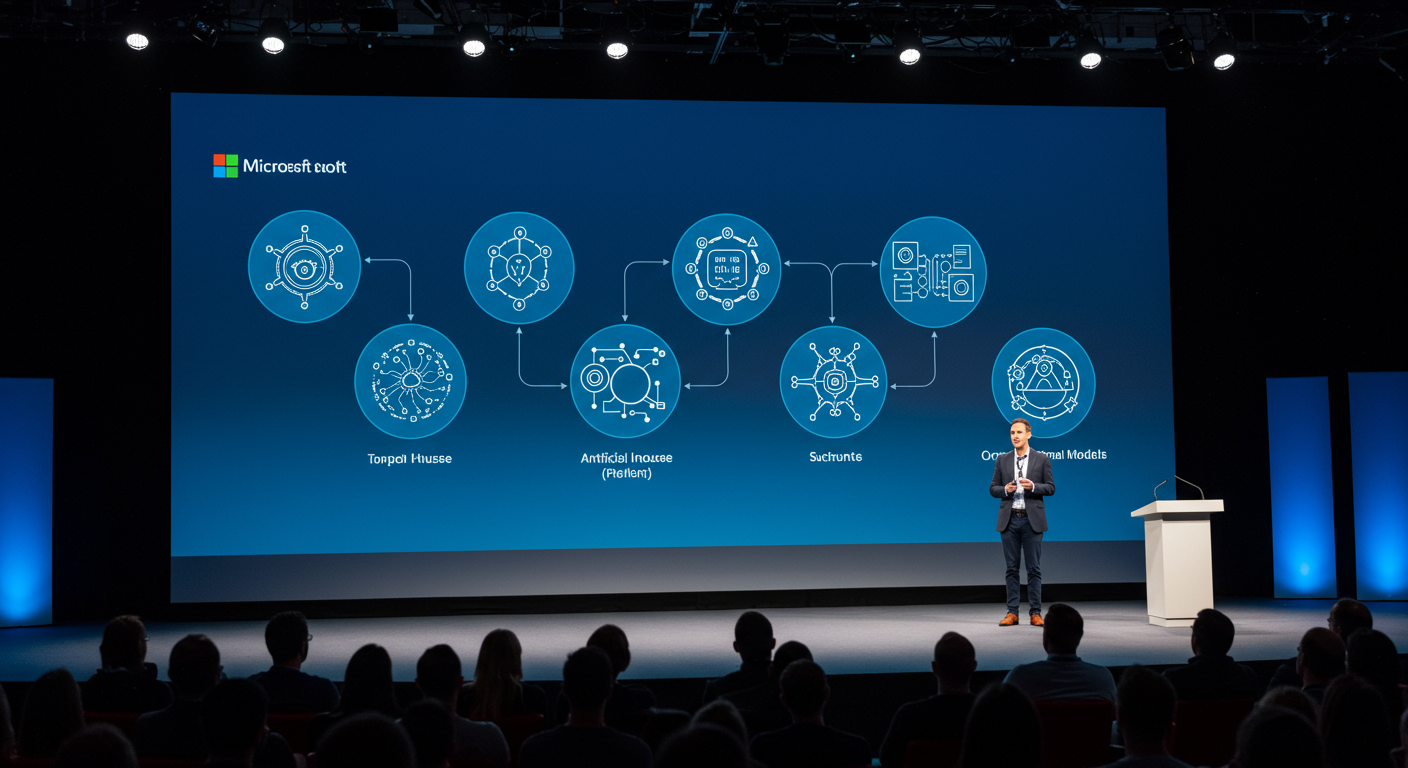
Microsoft used its Build conference to spotlight a new in-house MAI model family, adding a fresh data point to the company’s expanding AI ambitions. Reporting around the event described the launch as involving seven Microsoft-built models, though the exact count and naming should be understood in the context of how Microsoft presented the family across its Build, Azure, and corporate announcements.
The most consequential part of the rollout is not just the number of models. It is Microsoft’s apparent emphasis on a reasoning-capable model trained without OpenAI data, which points to a deeper level of internal model development than many observers typically associate with the company’s AI strategy.
What Microsoft announced at Build
At Build, Microsoft presented the MAI family as part of its broader effort to expand AI capabilities across its products, developer tools, and cloud platform. The announcement fits the company’s wider push to give customers access to multiple model options rather than tie every AI experience to a single underlying provider.
Some coverage summarized the reveal as seven in-house MAI models, but that phrasing appears to reflect how reporters aggregated details across multiple announcements. Microsoft’s own messaging points to the more important takeaway: the company is advancing a family of internally developed models that it can deploy across its software and cloud ecosystem.
Why training without OpenAI data matters
If Microsoft did characterize one of these systems as its first reasoning model trained without OpenAI data, that is the detail with the greatest strategic weight. It suggests Microsoft is building not only applications and infrastructure around AI, but more of the model layer itself.
That distinction matters. A model trained without OpenAI data is not the same as a full break from OpenAI, and the available sourcing does not support that broader conclusion. Microsoft still has deep commercial, technical, and platform ties to OpenAI. But developing a reasoning model on its own terms could give Microsoft more control over how certain AI systems are trained, tuned, priced, and deployed.
In practical terms, it also suggests less dependence in at least some parts of the stack. For a company selling AI tools to enterprises and developers at enormous scale, even a modest increase in internal model capability can have outsized implications.
What MAI appears designed to do
Based on Microsoft’s Build and Azure positioning, the MAI family appears aimed at practical deployment inside Microsoft’s broader AI ecosystem rather than as a standalone consumer spectacle. That likely means support for copilots, enterprise workflows, cloud services, and developer-facing tools that can be closely integrated with Azure.
Microsoft has spent the last two years emphasizing choice, orchestration, and platform-level AI services. In that context, MAI looks less like an isolated lab project and more like infrastructure Microsoft can use to strengthen product integration, optimize cost, and tailor performance for specific internal and enterprise workloads.
What remains less clear from the currently available public framing is how Microsoft wants these models compared with frontier offerings from OpenAI, Google, Anthropic, or Meta. Unless Microsoft published clear benchmarks or capability disclosures in its Build materials, it is better to view MAI first as a strategic platform move and only second as a pure performance statement.
How this fits Microsoft’s evolving AI strategy
Microsoft’s AI strategy increasingly resembles a dual-track approach. On one track, it remains one of OpenAI’s most important partners, embedding OpenAI-powered systems across flagship products and Azure services. On the other, it is building more of its own AI stack, from chips and infrastructure to orchestration layers and now, more visibly, models.
That combination gives Microsoft flexibility. Owning more of the model layer can help with margins, product control, customer customization, and negotiating leverage. It can also reduce the operational risk of depending too heavily on any single external model supplier, no matter how close the partnership may be.
Coverage from major tech outlets such as The Verge and TechCrunch has framed this as a meaningful sign of growing self-reliance rather than a clean strategic split from OpenAI. Based on the available sources, that is the most defensible reading.
What remains unclear
Several points still need careful qualification. The exact count of seven models may depend on how announcements were grouped across Microsoft’s event and blog materials. It is also not fully clear from the source set provided which models are immediately available, which remain at the research stage, and which are intended for broad Azure or product deployment.
There is also a wording issue around the label “reasoning model.” If Microsoft used that term directly, it carries more weight. If the term mainly comes from press interpretation, it should be treated more cautiously. The same is true of any suggestion that the MAI family is already competitive with the top frontier models; that would require direct, documented evidence.
In other words, the strongest version of the headline should remain anchored to what Microsoft explicitly said and what reputable reporting corroborated, not to assumptions that this launch marks a complete reordering of the company’s AI alliances.
The broader takeaway for the AI market
The significance of Microsoft’s MAI launch is less about a single product drop and more about what it signals. Microsoft appears to be moving further toward owning critical parts of the AI model stack itself, even while continuing to benefit from its OpenAI relationship.
For the market, that is an important strategic development. If Microsoft can deploy in-house models across Azure and its software portfolio at scale, it gains more control over economics, integration, and roadmap timing. That does not automatically make MAI a dominant new model family, but it does make Microsoft’s AI posture more independent than many had assumed.
The bottom line is measured but meaningful: Build appears to have marked a notable step in Microsoft’s in-house model ambitions. The long-term significance will depend on how broadly these MAI models are adopted inside Azure and Microsoft products, and on whether the company backs its strategic message with clear evidence on capability, availability, and real-world use.